Table of Contents
Picture this. You find a house you love, the price fits your budget, and then your lender says the loan program you were counting on will not work for that address. Plenty of buyers hit that same wall every year. They spend months house hunting and never check the two rules that decide everything.
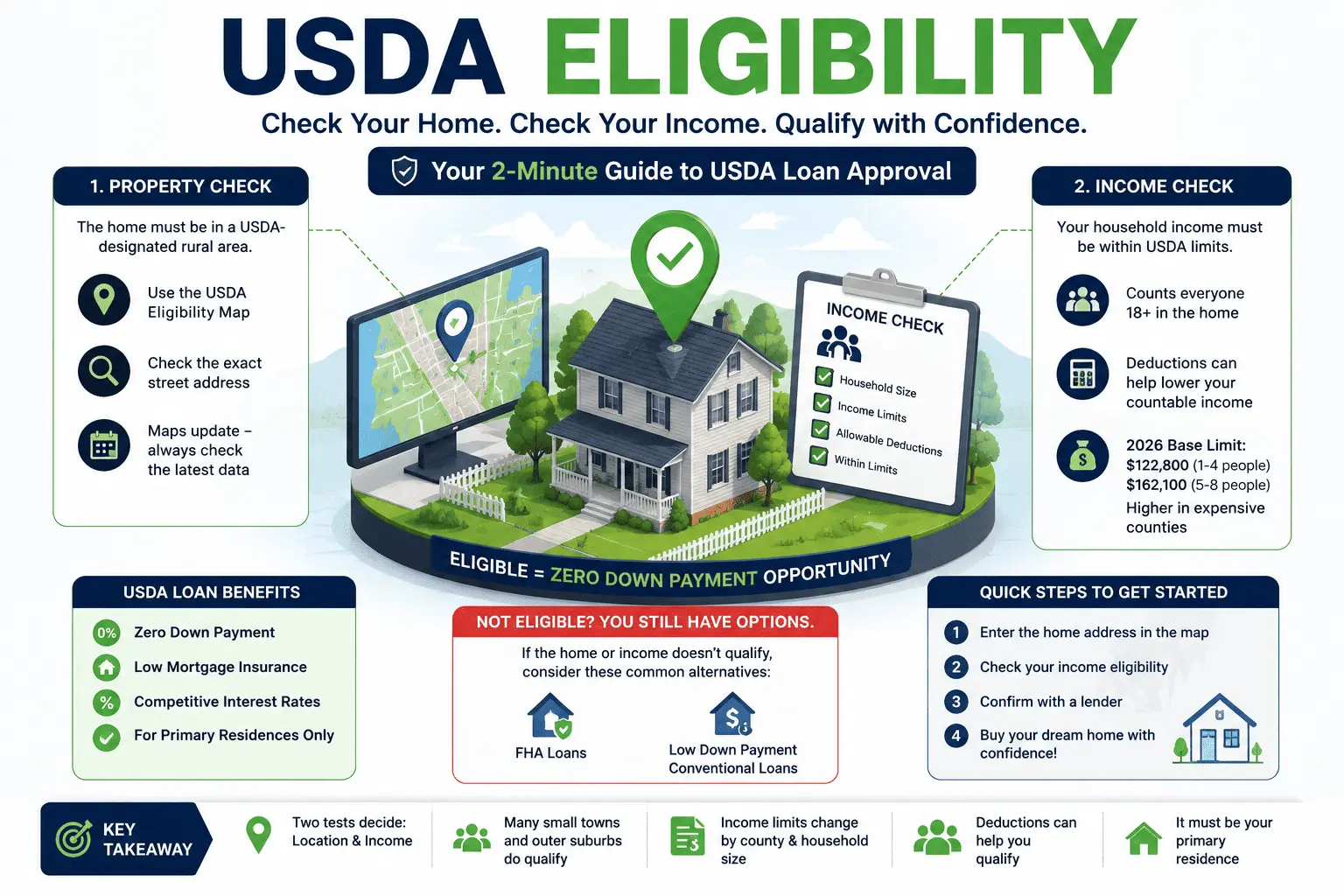
This guide clears that up before it costs you a home. You will learn how to confirm USDA Eligibility for any address in about two minutes, how the income math actually works, and what your options are if you land outside the limits. Everything sits in the same order a loan officer would walk you through it.
Key Takeaways
- Two tests decide the outcome: where the house sits, and how much your household earns.
- The USDA marks eligible areas on its own map. Many small towns and outer suburbs pass.
- The 2026 base income limit is $122,800 for households of 1 to 4 people and $162,100 for households of 5 to 8, with higher caps in expensive counties.
- Income from every adult in the home counts, even people who are not on the loan.
- Deductions for dependents, childcare, and elderly members can pull your countable income back under the cap.
- The house must be your main home. Rentals, flips, and vacation homes are out.
- Missing one rule does not end your search. FHA and low down payment conventional loans are the usual backups.
Address USDA Eligibility Checker
Everything starts with the address. Before you tour a home, run it through a checker. It takes seconds and saves you from falling in love with a property that can never work.
The check answers one plain question: does this exact parcel sit inside a USDA-designated rural area? Street-level lines matter here. Two houses on opposite sides of the same road can get different answers, so a ZIP code guess is never enough.
USDA Property Eligibility Map
The USDA Property Eligibility Map is the official record. Rural Development shades ineligible zones, usually the cores of larger cities, and leaves everything else open. Zoom all the way in until you see the individual street, not the county outline.
One warning worth repeating. The shading changes when the agency refreshes its data, so a map screenshot you saved last year may be out of date. Always check fresh before you write an offer.
Enter an address to verify its USDA loan eligibility:
Type the full street address, city, state, and ZIP. Partial entries drop you onto the wrong block. If the map returns a blank, try the address without unit numbers or directional prefixes like N or SW.
New construction gives people the most trouble. Brand new subdivisions sometimes have not been added to mapping databases yet. When that happens, drop the nearest existing address on the same street and confirm with a lender. Questions about a tricky address can go to james@allthings-mortgage.com for a manual look.
USDA Income Eligibility Lookup Tool
Most guides stop at the map. That is a mistake, because the USDA runs a second tool for income, and it is just as important as the first one. The property can be perfect and your file still gets declined on earnings.
The income tool asks for your state, county, and household size. It returns the exact cap for your area. Use it before you get attached to a price range, because the cap is tied to your county, not to the price of the home.
How To Use The USDAloansIndiana.com USDA Eligibility Map
Our map pulls the same underlying data the agency publishes, but it strips out the clutter. You get a yes or no in two steps instead of five. Here is the whole process.
Step 1: Enter A Home Address
Paste the address into the search bar. Include the ZIP for the cleanest result. If you are still browsing listings, enter the address of any home you are considering, or even a nearby intersection, to test the neighborhood.
Step 2: Review the USDA Eligibility Status
The result comes back in one of two forms. A clear pass means the parcel sits in an eligible zone. A fail means the property falls inside a shaded urban area and cannot be financed with this program. When you land right on a border, treat the USDA loan map result as a starting point and have a lender confirm in writing before you make an offer.
What Is a USDA Loan?
A USDA loan is a mortgage backed by the United States Department of Agriculture through its Rural Development arm. It exists for one reason: to help low and moderate income families buy homes outside big cities. Its headline feature is zero down payment, which no other widely available program offers except VA loans.
There are two separate programs, and mixing them up causes real confusion. The Section 502 Guaranteed program is the common one. A regular bank or mortgage company funds it, and the USDA insures the loan against loss.
The Section 502 Direct program works differently. The USDA itself is the lender, and it serves low and very low income households, generally those earning between 50% and 80% of the area median income. Direct loans can include a payment subsidy that lowers the monthly cost while you qualify for it.
The distinction matters because income caps differ sharply between the two. A household turned down for Direct may still pass the Guaranteed test, and the reverse happens too. Our full breakdown of USDA loan requirements covers underwriting details for both tracks.
USDA Loan Property Eligibility Requirements
The property side of USDA property eligibility comes down to four questions. Answer yes to all four and the home clears this stage.
- Location. The parcel must sit in a designated rural area on the official map.
- Occupancy. You have to live in it as your primary residence, and you generally need to move in within 60 days of closing.
- Type. Single-family homes, approved condos, townhomes, and modular homes all work.
- Use. The property cannot generate farm income or operate as a business.
Acreage rules trip people up. There is no hard acre cap, but the land value should not make up an outsized share of the total value, and the lot has to be typical for the neighborhood. A three-bedroom house on 20 acres of tillable ground will draw questions from an underwriter.
What Does the USDA Consider “Rural”?
The word “rural” misleads almost everyone. It does not mean farmland, gravel roads, or an hour from a grocery store. The USDA works from population thresholds and census data, not from how a place feels.
In broad terms, an area qualifies if its population sits under 35,000 and it lacks ready access to mortgage credit. That definition sweeps in a surprising amount of ground. Roughly 97% of American land area falls inside eligible boundaries, home to about a third of the population.
Real examples make this click. Towns with their own high schools, chain restaurants, and hospitals routinely qualify. Neighborhoods 20 minutes from a mid-sized city often qualify too, because the shaded ineligible zones hug city cores tightly.
Boundaries do shift. Congress has repeatedly extended older census baselines, which keeps some growing towns eligible longer than expected. That is another reason to check the current map rather than trusting what a neighbor told you two years ago.
Minimum Property Requirements
Passing the map is only half the property test. The house itself has to be safe, sound, and sanitary. An appraiser hired by your lender confirms this during the appraisal, and the standards follow HUD handbook guidance.
Think of it as a habitability review rather than a home inspection. The appraiser is not judging paint colors or dated cabinets. They are looking for conditions that make a home unsafe or unlivable.
Specific USDA Home Requirements
- A permanent, working heat source in every living area.
- Safe drinking water, plus a septic system or sewer connection that functions properly.
- A roof with a reasonable remaining life, usually a few years or more.
- No exposed wiring, no active leaks, and no major structural cracks.
- Functioning windows and doors with working locks.
- No peeling paint on homes built before 1978, because of lead risk.
- Safe, year-round access from a public or maintained private road.
Fixer-uppers can still work. If repairs are needed, the seller can complete them before closing, or the cost can sometimes be escrowed. Homes with missing kitchens, no heat, or serious foundation damage will not pass in as-is condition.
Other USDA Loan Requirements
Property rules and borrower rules are two separate gates. Clearing the map does nothing for you if your file fails underwriting. Here is what lenders check on the borrower side.
You must be a U.S. citizen, a permanent resident, or a qualified alien. Most lenders want a credit score around 640, since that unlocks the automated underwriting system, though manual review is possible below it with strong compensating factors. Ratios generally target 29% for housing costs and 41% for total debt, and waivers exist for borrowers with reserves or long job stability. A steady two-year work history is standard, and self-employed buyers should expect to provide two years of returns.
USDA loan eligibility also requires that you cannot already own a home that adequately meets your family’s needs within reasonable commuting distance. There is no first-time buyer rule, but this “adequate housing” test functions like one in practice.
2026 USDA Loan Income Limits
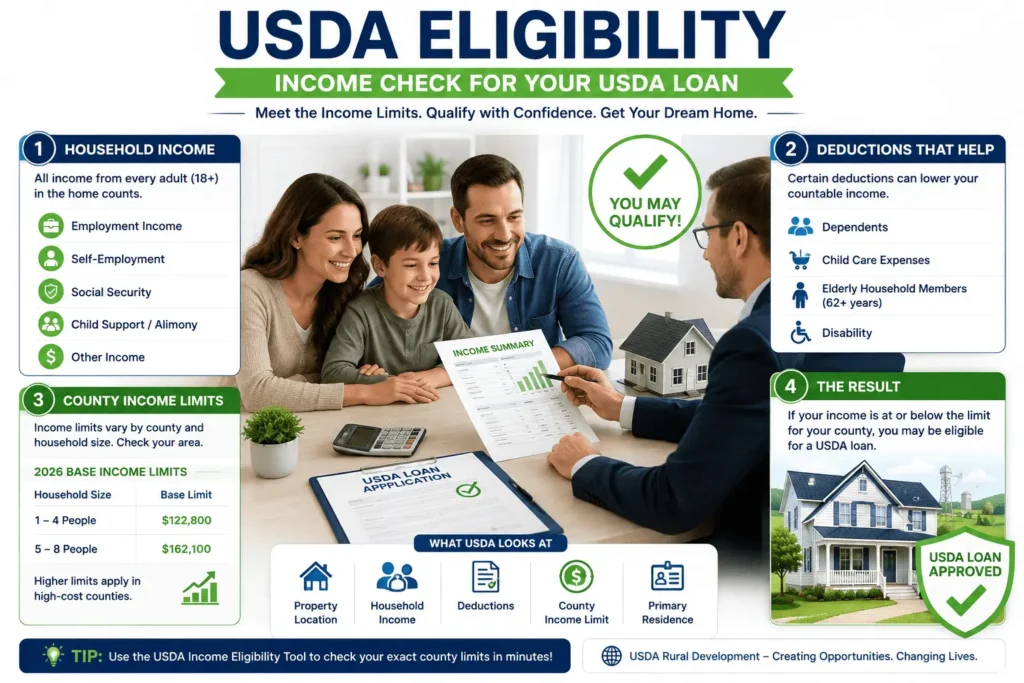
Income caps are set by county and household size, and they run at roughly 115% of the area median income. Larger households get more room. Expensive counties get more room still.
| Household Size | Standard Limit (Most Counties) | How It Works |
| 1 to 4 members | $122,800 | Applies across the majority of U.S. counties |
| 5 to 8 members | $162,100 | Larger families receive a higher ceiling |
| 9 or more members | Add about 8% per person | Each extra member adds 8% of the area’s 4-person limit |
| High-cost counties | Above standard | Parts of CA, WA, VA, HI, AK and select metros |
Always confirm your own county with the USDA lookup tool. Two counties that share a border can carry different caps.
Household Income vs. Repayment Income
This single distinction disqualifies more people than any other rule, and almost nobody explains it. The USDA runs two different income calculations on your file, and they serve different purposes.
Household income is the eligibility number. It counts earnings from every adult living in the home, whether or not they sign the loan. Your working adult child counts. A parent’s Social Security counts.
Repayment income is the affordability number. It counts only the stable, documented income of the borrowers on the application, and it drives your debt ratios. So a household can pass the repayment test easily and still blow past the eligibility cap because of a non-borrowing adult’s job.
Deductions That Lower Your Adjusted Household Income
Here is the good news most buyers never hear. The cap applies to your adjusted income, not your gross income. The USDA subtracts several allowances first, and those deductions can move a borderline household back into range.
- $480 per year for each dependent under 18, each full-time student, and each disabled family member.
- $400 per year for an elderly household, meaning the borrower or spouse is 62 or older, or disabled.
- Documented childcare costs for children under 12 that let a parent work or attend school.
- Medical expenses above 3% of gross income for elderly or disabled households.
- Certain disability-related expenses that make employment possible.
Run these numbers before you assume you earn too much. A family of five with two young children in daycare can shave several thousand dollars off the figure the USDA actually measures.
What Makes You Ineligible for a USDA Loan
Knowing the disqualifiers is faster than checking every rule one at a time. A file usually dies for one of these reasons.
- Adjusted household income above the county cap. This is the most common single cause.
- The property sits in a shaded ineligible area. There is no appeal and no exception.
- You already own adequate housing within commuting distance of the new home.
- Delinquency on federal debt. Defaulted student loans, unpaid federal taxes, or a prior government loan loss shows up in the CAIVRS screening.
- Suspension or debarment from federal programs.
- The home will not be your primary residence, including investment and second home plans.
- Non-citizen without qualifying status. Temporary visa holders generally do not qualify.
Two of these can be fixed. Federal debt can be brought current or placed in an approved repayment plan. Income can sometimes be recalculated once a working adult moves out or a deduction is properly documented. The rest are permanent for that particular purchase.
Required Documentation and Information
Lenders ask for more paperwork here than on a conventional loan, because they document the whole household, not just the borrowers. Gathering it early keeps your file moving.
- Photo ID and Social Security cards for all borrowers.
- Pay stubs covering the last 30 days for every working adult in the home.
- W-2s and full tax returns for the past two years, plus 1099s if you have them.
- Two months of complete bank statements, including every page.
- Award letters for Social Security, pension, disability, or child support income.
- Two years of business returns and a year-to-date profit and loss statement if self-employed.
- Childcare invoices or medical receipts if you are claiming deductions.
- A signed purchase agreement once you are under contract.
Missing pages cause the most delays. Send complete statements, even the ones that say “this page intentionally left blank.”
States with the Most USDA-Eligible Areas
Some states are almost entirely open territory for this program. Eligible ground tends to cluster where population density is low and metro areas are few.
- Mississippi, Arkansas, and West Virginia have among the highest shares of eligible land.
- Iowa, Kansas, Nebraska, and the Dakotas qualify nearly statewide outside a handful of metros.
- Kentucky, Alabama, and Montana offer wide coverage with only small shaded pockets.
- Indiana, Ohio, and Missouri qualify broadly once you step outside the largest metro rings.
Even heavily urbanized states hold eligible pockets. New York, Pennsylvania, and California all contain qualifying towns. If you are buying in the Midwest, our guide to USDA Loans Indiana breaks down county-level coverage in more detail.
What To Do If You’re Not USDA-Eligible
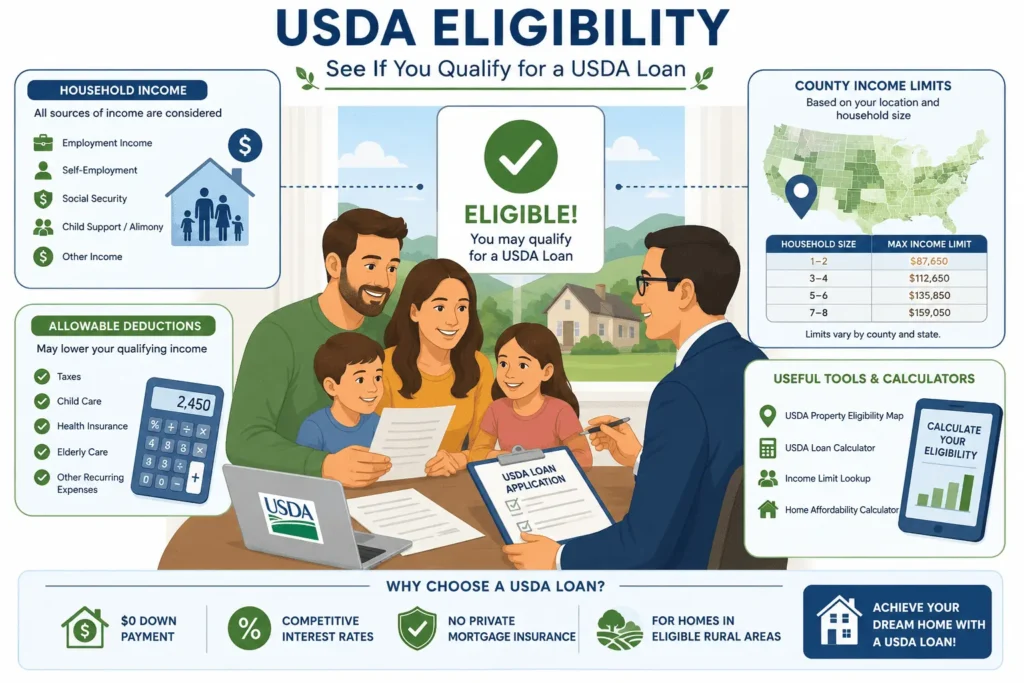
A failed check is not the end of your home search. It just means a different program fits better, and several of them still allow small down payments.
- FHA loans. 3.5% down with a 580 credit score, no income cap, and no location restriction. Often the closest substitute.
- Conventional 97 loans. 3% down for qualified buyers, with no geographic limit and no earnings ceiling.
- HomeReady and Home Possible. 3% down programs built for moderate income buyers, with reduced mortgage insurance.
- VA loans. Zero down with no income cap, if you or your spouse served.
- State and local down payment assistance. Many programs use higher income limits than the USDA and can be layered on top of an FHA or conventional loan.
If the map was the problem, widening your search by a few miles often solves it. If income was the problem, check whether deductions were applied correctly before you give up.
Next Steps
Run the address first, since a failed map check makes everything else pointless. Then check your county income cap using the USDA lookup tool with your true household size. If both come back clean, confirming USDA Eligibility with a lender is your next move, because only a lender can pull credit and issue a preapproval letter sellers will take seriously.
Gather your documents while you wait. Comparing current mortgage rates across two or three approved lenders is worth the hour it takes, since guarantee fees are fixed but interest rates are not.
More Helpful Tools and Calculators
Numbers make the decision easier than descriptions do. These tools help you test scenarios before you commit to anything.
USDA Loan Calculator
Estimates your monthly payment with the upfront guarantee fee and annual fee built in. Useful for seeing how zero down changes your real cost compared to a 5% down conventional loan.
Home Affordability Calculator
Works backward from your income and debts to a realistic price range. Pair it with the income cap so you are shopping inside both limits at once.
FHA Loan Calculator
Shows what the most common backup program would cost you. Running both side by side makes the tradeoff obvious.
2026 FHA Loan Limits
Lists the maximum you can borrow by county under FHA rules. Helpful if your target home sits above what a rural program will cover. A standard mortgage calculator rounds out the set for straight payment math.
Conclusion
At the start, this guide promised you a two-minute answer instead of a two-month guessing game, and every piece of that is now in your hands. You know how to read the map, how the household income rules really work, and which deductions can quietly move you back under the cap. You also know your exact backup options if the answer comes back no, which means no failed check has to stop your search. Confirming USDA Eligibility early is the cheapest step in the entire homebuying process, and it is the one that protects every step after it.
Frequently Asked Questions
How often is the USDA Eligibility Map updated?
Rural Development reviews boundaries periodically using census data, and updates typically arrive with a public comment window first. Changes are not frequent, but they do happen. Always verify an address the same week you plan to make an offer.
Can I use a USDA mortgage to buy a mobile or manufactured home?
Yes, with conditions. The home must be new or recently manufactured, permanently attached to a foundation, and titled as real property. Used mobile homes generally do not qualify, and the unit must meet HUD construction standards.
Can I use a USDA mortgage for an investment property or vacation home?
No. Occupancy as your primary residence is a strict requirement, and you must move in shortly after closing. Rental properties, flips, and second homes are all excluded. Buying one home while keeping another as a rental also raises the adequate housing question.
Do I have to be a first-time homebuyer to use a USDA mortgage?
No first-time buyer rule exists. Repeat buyers qualify regularly. The practical limit is the adequate housing test, which means you cannot keep a suitable home you already own within commuting distance of the new one.
Is there leniency for homes close to USDA-eligible areas?
None at all. The boundary is absolute, and a property either sits inside it or outside it. Homes directly across the street from eligible parcels get declined. Your only workaround is to shift your search area.
Can I still apply for a USDA mortgage with a low credit score?
Yes, though it gets harder below 640. Scores under that threshold usually require manual underwriting with documented compensating factors like cash reserves or a long rental history. Recent bankruptcies and foreclosures carry waiting periods.