
Table of Contents
You check your mortgage statement, and the number feels heavier than it used to. Rates moved, your neighbor refinanced last month, and now you are wondering if Chase can do the same for you. I felt this exact pull a few years back, staring at a loan document, unsure if switching lenders was worth the paperwork and the waiting.
This guide breaks down Chase Home Mortgage Refinance Rates in plain terms, so you know what to expect before you ever pick up the phone. By the end, you will understand how Chase sets its pricing, what loan types are on the table, and how to walk away with a lower payment. No confusing jargon, just the real steps homeowners actually need.
Chase’s Current Refinance Rates by Loan Type
Chase does not post one single number for everyone. Your rate depends on the loan type you pick, your credit profile, and how much equity sits in your home. Chase Home Mortgage Refinance Rates shift daily, so the figure you see today may look different next week. That is why lenders always tell you to get a fresh quote before locking anything in.
Loan type plays one of the biggest roles in what number you are offered. A shorter loan term usually comes with a lower rate, but a higher monthly payment. A longer term spreads the cost out but usually carries a slightly higher rate. Below is a general snapshot of how Chase structures its refinance pricing across common loan types.
| Loan Type | Typical Rate Behavior | Best For |
|---|---|---|
| 30-Year Fixed | Lower monthly payment, higher lifetime interest | Long-term homeowners |
| 15-Year Fixed | Higher monthly payment, faster payoff | Building equity fast |
| 5/6 ARM | Lower start rate, adjusts after 5 years | Short-term homeowners |
| Jumbo | Slightly higher rate, stricter approval | High-value homes |
30-Year Fixed Refinance Rate
The 30-year fixed loan stays the most requested option at Chase. Your payment stays the same every month for the full term. This works well if you plan to stay in your home for a long time and want a predictable bill. Many first-time refinancers pick this simply because it feels familiar and safe.
The tradeoff is that you pay more interest over the life of the loan compared to a shorter term. If your main goal is a lower monthly payment right now, this option usually wins. If your goal is paying off your home faster, keep reading below.
15-Year Fixed Refinance Rate
A 15-year loan usually carries a lower interest rate than the 30-year option. Your monthly payment goes up, but you pay far less interest overall. Homeowners who want to be debt-free sooner often pick this route.
This option works best if your income is stable and you can comfortably handle a bigger monthly bill. It also builds equity much faster than a 30-year term. Some borrowers even switch from a 30-year to a 15-year loan purely to shave years off their mortgage.
5/6 and 7/6 ARM Refinance Rates
Adjustable-rate loans start with a lower rate for a fixed window, usually five or seven years. After that window closes, the rate adjusts based on the market. This can work if you plan to sell or refinance again before the adjustment period hits.
The risk is uncertainty once the fixed window ends. If rates climb during that time, your payment could rise with it. This loan type suits homeowners with a clear short-term plan rather than those staying put for decades.
Jumbo Refinance Rates
Jumbo loans cover amounts above the standard conforming loan limit. Chase treats these with tighter underwriting rules and slightly different pricing. If your loan balance is large, expect extra paperwork and a closer look at your finances.
Lenders see jumbo loans as slightly higher risk simply because of the size of the balance. That means your credit score and reserves matter even more here. Homeowners with strong financial profiles usually still land competitive rates on jumbo refinances.
What Determines Your Chase Refinance Rate
No two homeowners get the exact same number. Chase Home Mortgage Refinance Rates are built from a mix of personal and loan-level factors. Understanding these pieces helps you know where you stand before you apply, and it helps you fix weak spots before a lender points them out.
Credit Score
Your credit score carries real weight in this process. A higher score usually unlocks a lower rate offer. Even a small score jump before you apply can shift your pricing in your favor.
Paying down credit card balances and avoiding new debt before applying can help your score. Late payments in the last twelve months tend to hurt the most. Check your score a few months before you plan to refinance so you have time to fix any issues.
Loan-to-Value Ratio and Home Equity
This ratio compares your loan balance to your home’s current value. More equity in your home generally means better pricing. Lenders see lower risk when you have more skin in the game.
If home values in your area have risen since you bought, your equity may already be higher than you think. A lower loan-to-value ratio can also help you avoid extra mortgage insurance costs. This is worth checking before you assume you need a big down payment to refinance.
Debt-to-Income Ratio
Chase looks at how much of your monthly income already goes toward debt. A lower ratio signals that you can comfortably handle the new payment. Paying down other balances before you apply can help this number.
Lenders typically want to see your total monthly debt payments stay under a certain share of your income. This includes car loans, credit cards, and student loans, not just your mortgage. Reducing even one recurring bill before applying can make a real difference.
Discount Points
You can pay an upfront fee to buy down your interest rate. This is called a discount point, and one point usually costs one percent of your loan amount. It only makes sense if you plan to stay in the home long enough to recover that cost.
Discount points work best for homeowners who are certain they are not moving anytime soon. If you might sell or refinance again within a few years, points often are not worth paying. Always ask your lender to show you the breakeven timeline for any points offered.
Interest Rate vs. APR: What Chase’s Numbers Actually Mean
These two numbers often get mixed up, but they mean different things. The interest rate is what you pay on the loan balance itself. The APR wraps in extra costs like fees and points, giving you the true yearly cost of the loan.
When you compare Chase Home Mortgage Refinance Rates against another lender, always look at both numbers side by side. A lender with a lower rate but a much higher APR may not actually save you money. Reading both figures together gives you the full picture before you sign anything.
A wide gap between the rate and the APR usually means the lender is charging heavier upfront fees. A small gap usually means fewer fees baked into the loan. Ask your loan officer to explain any gap you notice before moving forward.
Types of Refinance Loans Chase Offers
Chase gives homeowners more than one path to refinance. Picking the right type depends on your goal, whether that is a lower payment, extra cash in hand, or switching loan programs entirely.
Rate-and-Term Refinance
This option replaces your current loan with a new rate or term, without pulling cash out. Most people choose this to lower their monthly payment or switch from an ARM to a fixed loan. It is usually the simplest and cheapest refinance path.
Because you are not borrowing extra money, underwriting tends to move a bit faster too. This makes it a popular first choice for homeowners simply chasing a lower rate.
Cash-Out Refinance
A cash-out refinance lets you borrow more than you owe and pocket the difference. Homeowners use this for renovations, debt payoff, or other large expenses. Your new loan balance and payment will both go up, so plan carefully.
Lenders usually cap how much equity you can pull out, often leaving a portion untouched as a safety cushion. Interest rates on cash-out loans also tend to run a touch higher than a standard rate-and-term refinance. Weigh the extra cost against what you actually plan to use the money for.
FHA and VA Refinance
If your current loan is FHA or VA backed, Chase offers streamlined refinance paths for these programs. These often require less paperwork than a standard refinance. Eligible veterans and FHA borrowers should ask about these options directly.
Streamlined programs often skip a full appraisal, which can save both time and money. They are built specifically to make refinancing easier for borrowers already in these loan programs. Not everyone qualifies, so confirming eligibility early saves a wasted application.
DreaMaker Refinance
Chase’s DreaMaker program is built for borrowers with more modest income levels. It can come with reduced mortgage insurance costs and flexible down payment rules. Ask a Chase advisor if your income and loan type qualify.
This program can also open the door for borrowers who assumed they needed a large equity cushion to refinance. Income limits do apply and vary by location, so check current guidelines with your advisor.
How to Refinance Your Mortgage With Chase (Step-by-Step)
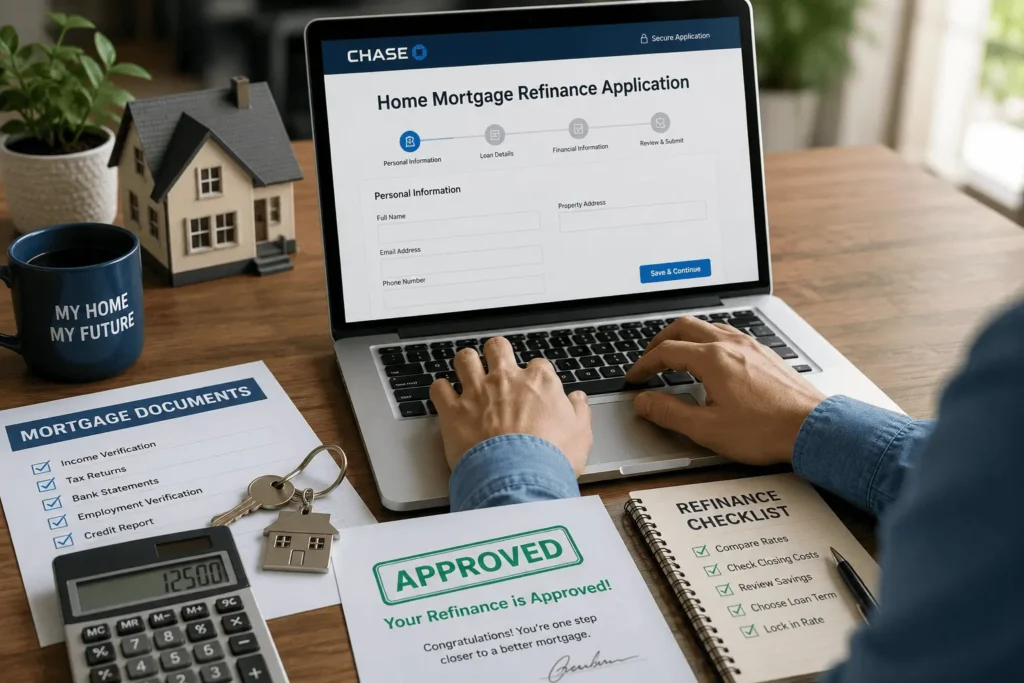
The refinance process feels less scary once you break it into steps. Here is the general path most Chase borrowers follow.
- Check your credit score and current home equity
- Gather income and asset documents
- Apply online or speak with a Home Lending Advisor
- Lock your rate once you are comfortable with the offer
- Complete the appraisal and underwriting review
- Sign closing documents and finalize the new loan
Applying Online vs. Working With a Home Lending Advisor
You can start your application through Chase Mortgage Login if you already bank with them, which pulls in some of your existing details automatically. Some homeowners prefer speaking with a live advisor instead, especially for cash-out or jumbo loans. Either path leads to the same underwriting process in the end.
If you have questions about your options before you even begin, Chase Mortgage Phone Number support can walk you through the basics ahead of a formal application. This is often useful if your situation is a bit unusual, such as self-employment income.
Documents You’ll Need
Chase will ask for recent pay stubs, tax returns, and bank statements. You will also need your current mortgage statement and homeowner’s insurance information. Having these ready before you apply can speed things up.
Self-employed borrowers usually need extra documentation, such as two years of business tax returns. Keeping digital copies of everything ready ahead of time avoids delays once underwriting begins.
Appraisal and Underwriting
Once your application is submitted, Chase orders a home appraisal to confirm current value. Underwriting then reviews your full financial picture against the loan terms. This stage usually takes the longest part of the timeline.
Underwriters may come back with extra questions or requests for updated paperwork. Responding quickly keeps your file moving instead of sitting idle in a queue.
Typical Closing Timeline
Most Chase refinances close within 30 to 45 days from application to signing. Jumbo loans or cash-out refinances can take a bit longer due to extra review steps. Staying quick with document requests helps keep your timeline on track.
Rate locks usually last 30 to 60 days, so timing your application with your lock window matters. If your closing runs long, ask your advisor about extending the lock rather than risking a rate change.
Chase Refinance Closing Costs and Fees
Refinancing is not free, even though you are not buying a new home. You can reach out to james@allthings-mortgage.com anytime you want a second opinion on the fee breakdown Chase sends you. Expect the following common charges:
- Loan origination fee
- Appraisal fee
- Title search and insurance
- Recording fees
- Prepaid interest and escrow setup
Some of these costs can be rolled into your new loan balance instead of paid upfront. Ask your advisor which fees are negotiable before you lock your rate. Closing costs typically run between two and five percent of your total loan amount, so it pays to ask for an itemized list early.
How to Get a Lower Refinance Rate From Chase
A lower rate saves you real money over the life of your loan. Checking Chase refinance rates today against a few other lenders is one of the smartest moves you can make before locking anything in.
Chase Relationship and Autopay Discounts
Chase sometimes offers a small rate discount if you already hold a checking or savings account with them. Setting up autopay for your mortgage can also shave a bit off your rate. These small discounts add up over a 30-year term.
Ask your loan officer directly which discounts you qualify for, since they are not always advertised upfront. Even a small rate reduction can save thousands over the life of a large loan.
Timing and Locking Your Rate
Rates move daily based on the broader market. Once you find a number you are comfortable with, locking it protects you from increases before closing. Waiting too long to lock can cost you if rates climb during underwriting.
Some lenders offer a float-down option, letting you grab a lower rate if the market drops after you lock. Ask if this is available before committing to your lock period.
Comparing Chase’s Quote Against Other Lenders
Never accept the first offer without checking at least two other lenders. Comparing Chase Home Mortgage Refinance Rates against competitors gives you leverage and confirms you are getting a fair deal. Even a quarter-point difference matters on a large loan balance.
Getting quotes within the same short window also helps, since rates shift daily and comparing old quotes against new ones is not a fair test.
Chase Refinance Rates vs. Other Major Lenders
Chase is one of several large lenders competing for your refinance business. Here is how it generally stacks up against a few common alternatives.
Chase vs. Wells Fargo
Both lenders offer similar loan types and comparable rate ranges. Chase tends to have a smoother online application, while Wells Fargo sometimes offers more branch locations for in-person support. Your personal comfort with online versus in-person service may matter as much as the rate itself.
Chase vs. Bank of America
Bank of America also offers relationship-based rate discounts, similar to Chase. Your final rate with either lender often comes down to your personal credit profile more than the lender name itself. Comparing loan estimates side by side is still the safest way to choose.
Chase vs. Rocket Mortgage
Rocket Mortgage is known for a fully digital process with fast turnaround times. Chase offers a similar online path but also gives you the option of a dedicated human advisor throughout. If you like having someone to call directly, Chase may feel more comfortable during a stressful process.
Should You Refinance With Chase? Pros, Cons, and Breakeven Point
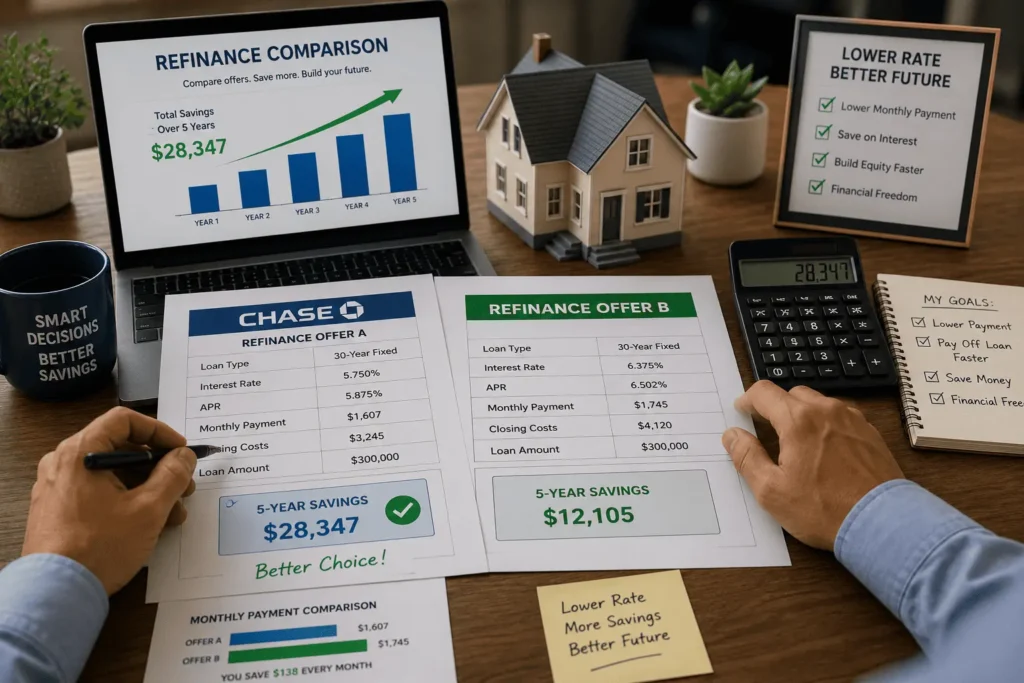
This is the real question behind all the numbers above. The answer depends on your goals, your current rate, and how long you plan to stay in your home. Reading a full breakdown, like the one on Is Chase Mortgage a Smart Choice for Your Home Loan?, can help you weigh the lender itself before you commit to their refinance offer.
Pros
- Wide range of loan types, including jumbo and government-backed options
- Relationship discounts for existing Chase customers
- Established lender with a long track record
Cons
- Closing costs can be higher than smaller lenders
- Rate discounts require an existing Chase account
- If you already hold a very low rate, refinancing may not make sense — some homeowners instead look into a portable mortgage to keep their existing rate while moving to a new home
Calculating Your Breakeven Point
Your breakeven point is when your monthly savings finally cover your closing costs. You can estimate this with a Chase Mortgage Calculator by dividing your total closing costs by your monthly savings amount. If you plan to stay in your home past that point, refinancing usually makes financial sense.
If you are close to selling within a year or two, the math may not work in your favor. Running this number honestly, rather than skipping it, is the single best way to avoid a refinance you regret.
Conclusion
As promised at the start, you now have a clear, plain-language breakdown of how Chase Home Mortgage Refinance Rates actually work. You know what shapes your rate, which loan types fit different goals, and how Chase compares against other major lenders. Once your new loan closes, you can even manage your bill directly through Chase Mortgage Payment tools without extra hassle. If you still have questions along the way, reaching out to a Chase advisor directly is always your safest next move.
Frequently Asked Questions
Can you refinance a fixed-rate mortgage with Chase?
Yes, Chase allows you to refinance an existing fixed-rate mortgage into a new fixed or adjustable loan. This can lower your payment or shorten your term. Your new rate depends on your credit, equity, and current market pricing at the time you apply.
Can you refinance and keep the same rate?
Refinancing usually changes your rate, since it replaces your loan entirely. If your goal is only to keep your current rate while moving, a portable mortgage may fit better than a standard refinance option.
Can you refinance an ARM into a fixed-rate loan with Chase?
Yes, many homeowners refinance an adjustable-rate loan into a fixed-rate loan before the adjustment period begins. This locks in predictable payments going forward. Chase treats this as a standard rate-and-term refinance application.
How long does Chase take to close a refinance?
Most Chase refinances close in 30 to 45 days from the application date. Jumbo and cash-out loans can take slightly longer due to extra underwriting steps. Having your documents ready upfront helps speed the process along.
Does Chase charge prepayment penalties?
Chase generally does not charge prepayment penalties on standard residential refinance loans. Always confirm this directly in your loan agreement before signing, since terms can vary by loan type and state.