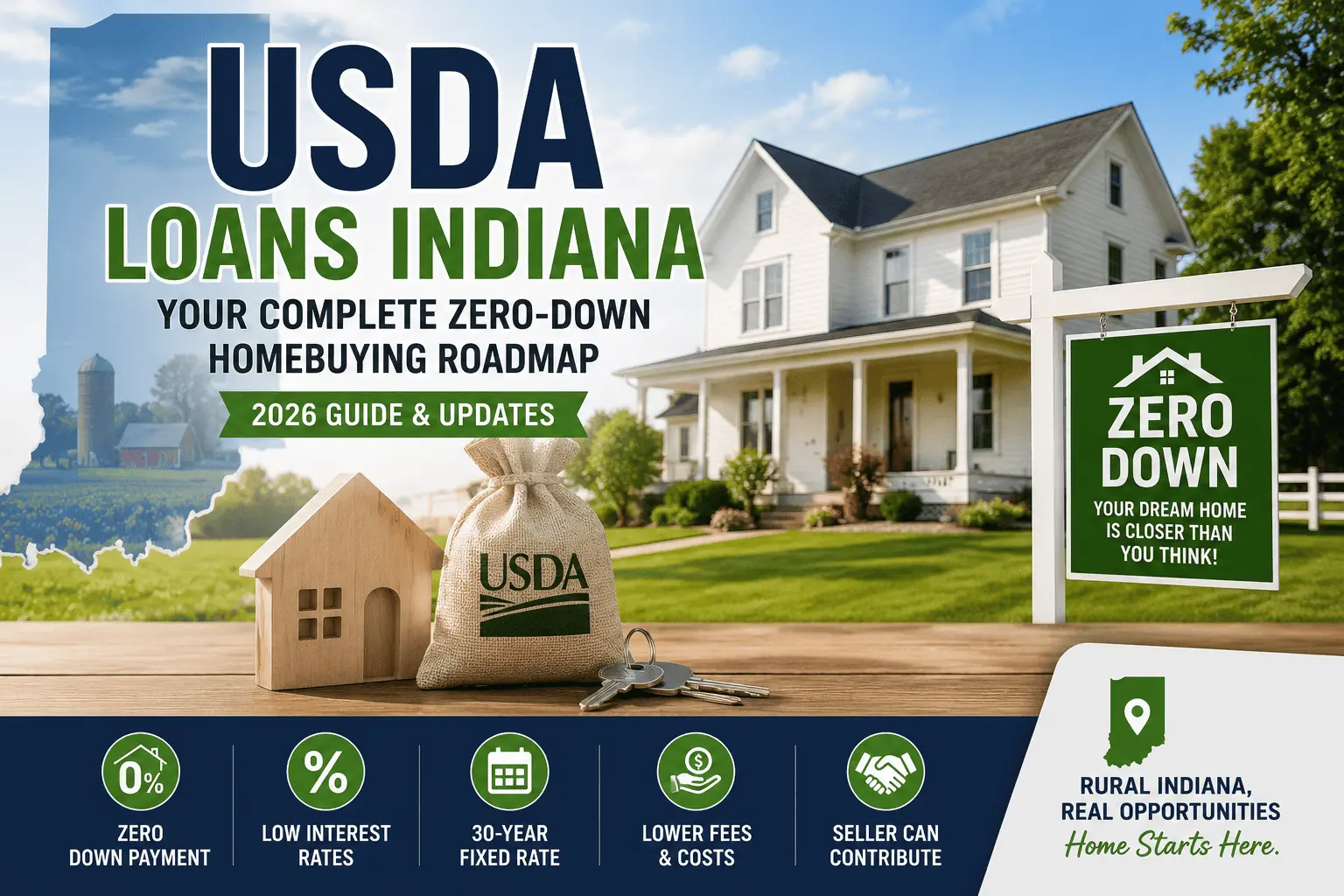
Saving a down payment in Indiana can feel like running on a treadmill. Rent climbs, home prices climb faster, and the savings account never catches up. I watched a cousin near Bloomington quit her home search twice before anyone told her about a zero-down program she already qualified for. That gap between what buyers qualify for and what they actually know about is the real problem.
This guide closes that gap. You will get the current income limits, today’s rates, the map rules, and the exact steps to apply for usda loans indiana lenders approve every week. Every figure here comes straight from USDA Rural Development and reflects July 2026 updates. By the end, you will know whether this loan fits you and what your next move should be.
What Is a USDA Loan?
A USDA loan is a home loan backed by the U.S. Department of Agriculture. It exists to help people buy homes in rural and small-town areas. The main draw is simple: no down payment. The government backing lets lenders offer that deal without taking on extra risk.
USDA Direct vs USDA Guaranteed Loans
The Guaranteed program runs through banks and mortgage companies. USDA promises to cover the lender’s loss if you default, so private lenders handle everything.
The Direct program is different. USDA itself lends you the money. It serves low-income and very-low-income households and comes with payment help that private lenders cannot match.
Why Choose a USDA Loan in Indiana?
Indiana has a lot of eligible land. Small towns, farm communities, and even some suburbs fall inside the eligible zones. For a buyer with steady income but thin savings, that combination is hard to beat.
Who USDA Loans Work Best For
These loans suit buyers with moderate income, decent credit, and little cash saved. They also work well for anyone who wants a small-town lifestyle. Many people using usda loans indiana wide are teachers, nurses, factory workers, and young families priced out of Indianapolis or Fort Wayne.
What Changed for Indiana USDA Borrowers in 2026
Two important updates landed this summer. Most competing articles still show old numbers, so check dates before trusting any figure you read.
New Income Limits Effective July 13, 2026
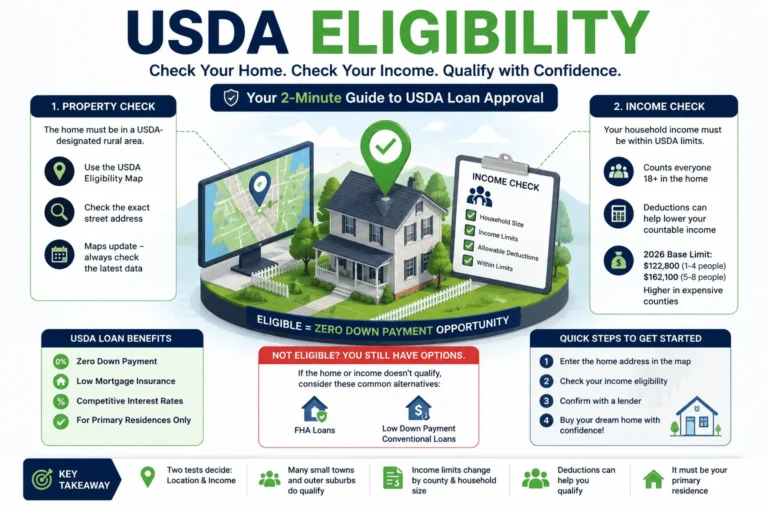
USDA published fresh income limits through a Procedure Notice on July 13, 2026. The new ceiling is $122,800 for a household of one to four people. Households of five to eight can earn up to $162,100. These figures apply to most Indiana counties, though a few high-cost areas sit higher.
If you were told last year that you earned too much, run the numbers again. The limit moved up by roughly $3,000. Questions about your specific county? Email james@allthings-mortgage.com for a quick check.
Current Direct Loan Interest Rate (Updated July 1, 2026)
The Section 502 Direct rate is 5.250% as of July 1, 2026. USDA reviews this rate regularly, so it can shift. Guaranteed loan rates are set by lenders and change daily.
Eligibility Map Status and Next Review Cycle
USDA reviews eligible areas roughly every five years using census data. Areas can lose eligibility when population grows. Always verify an address before writing an offer.
Indiana USDA Loan Benefits
The advantages stack up quickly once you compare them side by side. Here is what makes usda loans indiana buyers choose over other options.
No Down Payment
You can finance 100% of the purchase price. That single feature removes the biggest barrier most renters face.
Competitive Interest Rates
Government backing lowers lender risk, and that shows up in your rate. USDA rates usually track close to conventional rates, sometimes slightly below. Shopping matters, so compare at least three mortgage rate quotes before you commit.
30-Year Fixed Loan Terms
Guaranteed loans come as 30-year fixed mortgages only. No adjustable rates, no balloon payments. Your principal and interest stay the same for three decades.
Finance Eligible Closing Costs
Here is a feature most buyers miss. If the home appraises for more than the purchase price, you can borrow the difference and use it for closing costs. Say you buy at $220,000 and it appraises at $228,000. That $8,000 gap can cover closing costs, eligible repairs, or even appliances.
Lower Fees Than FHA Mortgage Insurance
USDA charges 1% upfront and 0.35% yearly. FHA charges 1.75% upfront and 0.55% yearly. Over a full loan term, that difference often saves more than $20,000.
Seller Can Contribute Up to 6% Toward Closing Costs
Sellers may pay up to 6% of the purchase price toward your costs. Combined with the appraisal gap trick above, many buyers close with almost nothing out of pocket.
Indiana USDA Loan Eligibility Requirements
Qualifying comes down to four things: your income, your credit, your debts, and the property itself. Miss any one and the file stops. Understanding these rules early saves weeks of wasted effort on usda loans indiana applications.
Income Requirements
Your household income must stay at or below 115% of the area median income. USDA counts everyone in the home, not just people signing the loan. That surprises many applicants.
Credit Score Requirements
There is no official minimum score. In practice, 640 is the line that matters. At 640 or above, your file usually runs through the automated system and moves fast. Below 640, an underwriter reviews everything by hand, which means more paperwork and stricter rules.
Debt-to-Income Ratios: 29% Housing / 41% Total
USDA uses two ratios. Your housing payment should stay near 29% of gross monthly income. All your debts together should stay near 41%. Both are guidelines, not hard walls.
Ratio Waivers and Compensating Factors
Files can be approved above those ratios. Strong credit, cash reserves, a long job history, or a payment similar to your current rent all help. The automated system grants many of these waivers on its own.
Employment and Income Documentation (Self-Employed, Seasonal, Farm Income)
Most borrowers need two years of steady work history, though job changes within the same field are fine. Self-employed buyers show two years of tax returns. Farm income and seasonal work count too, but lenders average it across two years.
Property Eligibility
The home must sit inside an eligible area and be your primary residence. It also has to be safe, sound, and livable. Working heat, sound plumbing, a solid roof, and safe road access are all required.
Borrower Eligibility
You must be a U.S. citizen, a non-citizen national, or a qualified alien. You need to be 18 or older and legally able to sign a loan. You can qualify even if you owned a home before, as long as you do not currently own a suitable home nearby.
Eligible Rural Areas in Indiana
Most of Indiana’s land area qualifies. The exceptions cluster around big cities. Anyone researching indiana first-time home buyer programs should check the map early, because location decides everything.
Indiana USDA Income Limits (2026)
Income Limits by Household Size
| Household size | 2026 limit (most Indiana counties) |
| 1–4 people | $122,800 |
| 5–8 people | $162,100 |
| 9 or more | Add roughly 8% per person |
Indiana USDA Income Limits by County
These are the figures every usda loans indiana application is measured against. Most Indiana counties use the standard limits above. Counties inside the Indianapolis metro often run higher because median incomes there are stronger. Always confirm your exact county on the USDA eligibility website before making plans.
How USDA Calculates Household Income
USDA uses three separate income figures, and mixing them up causes real confusion.
- Annual income: every dollar earned by every adult in the household
- Adjusted income: annual income minus allowed deductions, compared against the limit
- Repayment income: only stable, documented income from borrowers, used for the ratios
Deductions That Lower Your Adjusted Income
This section saves more applications than any other. Allowed deductions include $480 per dependent child, $400 for an elderly household, verified childcare costs, and certain medical or disability expenses. A family of five with two kids and daycare costs can drop several thousand dollars off their counted income.
How Non-Borrowing Household Members Affect Eligibility
An adult child with a job, a parent living with you, or a spouse not on the loan all add to household income. Their income counts toward the limit even though it cannot be used to qualify. This trips up more first time home buyers indiana lenders work with than any other rule.
USDA Eligibility Map for Indiana
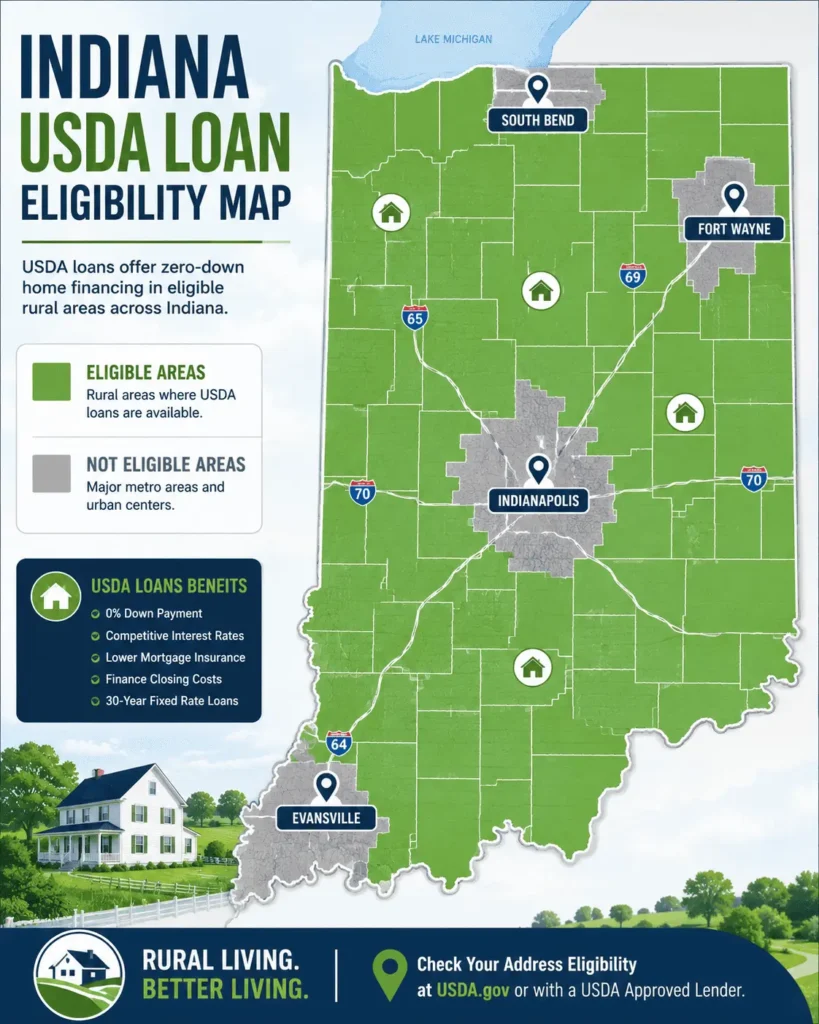
Location decides whether usda loans indiana buyers can use the program at all. Check it first.
How to Check Property Eligibility
Visit the USDA eligibility website and choose the single family housing option. Type the full property address, including city and ZIP code. The tool returns a clear eligible or not eligible result within seconds.
How USDA Defines “Rural” (Population Thresholds)
USDA uses three population tiers. Areas under 10,000 people qualify. Areas of 10,001 to 20,000 qualify if they sit outside a metro area and lack affordable mortgage options. Areas of 20,001 to 35,000 qualify only if they were rural in an earlier census and still lack lending access.
Indiana Areas That Are NOT USDA Eligible
The core of Indianapolis and its inner suburbs are excluded. So are Fort Wayne, Evansville, South Bend, Bloomington, Lafayette, and the Lake County corridor near Chicago. Ineligible zones follow city boundaries, not county lines.
Indiana Towns Near Metro Areas That Surprisingly Qualify
Plenty of towns within a 30-minute commute of a city still qualify. Communities in Brown, Jennings, Orange, Perry, and Pulaski counties frequently pass. Never assume, though. A street can be eligible while the next street over is not.
Counties Eligible for USDA Financing
Nearly every Indiana county has at least some eligible ground. The southern and western counties have the widest eligible zones. Central counties near Indianapolis have the smallest.
What Happens If the Map Changes After You Apply
If a property is eligible when USDA issues your commitment, you keep that eligibility. Existing borrowers in areas that later lose eligibility can still refinance their USDA loan.
USDA Loan Costs and Fees in Indiana
No down payment does not mean no cost. Here is exactly what usda loans indiana borrowers pay.
1% Upfront Guarantee Fee
You pay 1% of the loan amount at closing. On a $220,000 loan that is $2,200. Almost everyone rolls it into the loan instead of paying cash.
0.35% Annual Fee (USDA’s Version of Mortgage Insurance)
The annual fee is 0.35% of your average balance, split across 12 monthly payments. On a $220,000 loan that runs about $64 a month. Unlike conventional PMI, it stays for the life of the loan, but it shrinks as your balance drops.
Typical USDA Closing Costs in Indiana
Expect 2% to 5% of the purchase price. That covers appraisal, title work, recording fees, and prepaid taxes and insurance. Seller credits and lender credits can wipe out most of it.
Sample Monthly Payment on an Indiana Home
On a $220,000 home at 6.25% with the fee financed, principal and interest run near $1,368. Add the $64 annual fee, plus taxes and insurance, and you land around $1,750 total. Run your own numbers with a mortgage payment calculator before you shop.
How Indiana’s Homestead Deduction and Property Tax Cap Affect Your Payment
Indiana caps homestead property taxes at 1% of assessed value. The standard homestead deduction lowers that assessed value further. Both reduce your escrow payment, which improves your debt ratios and helps you qualify for more house.
How Much Can You Borrow?
Loan Limits
Guaranteed loans have no set maximum. Your income and repayment ability set the ceiling, not a county chart.
Area Loan Limits for USDA Direct Loans in Indiana
Direct loans work differently. The home’s market value cannot exceed the published area loan limit for that county. USDA maintains a county-by-county map showing these figures.
What Really Caps Your Loan Amount: Repayment Ability
Lenders start with your gross income and subtract your monthly debts. Whatever is left, measured against the 41% guideline, decides your maximum payment. That payment then converts into a loan amount at current rates.
Maximum Financing Available
You can finance 100% of the purchase price, plus the guarantee fee. When the appraisal comes in high, you can finance a bit above the price too.
USDA Loan Interest Rates
Rates on usda loans indiana buyers receive come from two different places, depending on which program you use.
Current Guaranteed Loan Rates
Lenders set these rates, and they move daily. In mid-2026 they have generally tracked in the 6% to 6.75% range for 30-year fixed loans.
Current Direct Loan Rate and Payment Assistance Subsidy
The Direct rate sits at 5.250% as of July 1, 2026. Payment assistance can push the effective rate as low as 1% based on your adjusted income. That subsidy must be partly repaid when you sell or move out.
Repayment Terms
Guaranteed loans run 30 years. Direct loans run up to 33 years, or 38 years for very low-income applicants who cannot afford the shorter term.
When to Lock Your Rate
Lock once you have a signed purchase agreement and a firm closing date. USDA files add a government review step, so a 45-day or 60-day lock is safer than 30. If you already own a home and want to keep a low rate, read about portable mortgage rates before selling.
Indiana Property Requirements and USDA Appraisal
USDA Appraisal vs Home Inspection
The appraisal is required and protects the lender. It confirms value and checks basic safety. A home inspection is optional but strongly recommended, because it protects you.
Well and Septic Requirements for Rural Indiana Homes
Many rural Indiana homes use private wells and septic systems. USDA requires a water test showing the supply is safe to drink. The septic system must be working and properly sized.
Acreage, Outbuildings, and Land Value Rules
Extra land is allowed if it is typical for the area. Land value should not make up an unusually large share of total value. Barns and sheds are fine as long as they are not used for a business.
Manufactured Homes, Condos, and New Construction
New manufactured homes on permanent foundations can qualify. Condos and townhomes qualify if the project meets agency standards. New construction is allowed with proper builder documentation and warranties.
Flood Zone Requirements
Homes in a designated flood zone need flood insurance. New construction in a flood zone faces extra restrictions and is often declined.
How to Apply for a USDA Loan in Indiana
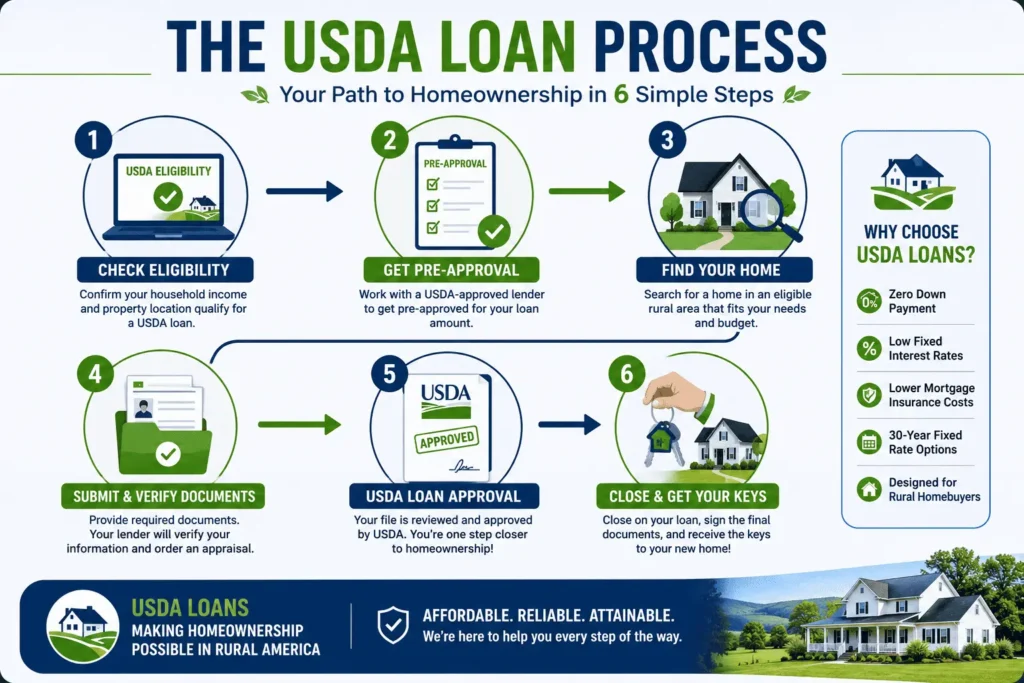
Applying for usda loans indiana lenders handle follows a clear path. Most delays come from missing paperwork, not from the program itself.
Application Process
- Check the property address on the USDA map
- Confirm your household income against the county limit
- Get pre-approved with a USDA-approved lender
- Find a home and sign a purchase agreement
- Complete the appraisal and underwriting
- Wait for USDA’s conditional commitment
- Close and get your keys
Required Documents
- Two years of W-2 forms and tax returns
- 30 days of recent pay stubs
- Two months of bank statements
- Photo identification and Social Security number
- Income details for every adult in the household
GUS Underwriting and the USDA Conditional Commitment
Your lender runs the file through GUS, USDA’s automated underwriting system. An “Accept” result speeds everything up. The file then goes to USDA for a conditional commitment, which is the agency’s formal sign-off before closing.
Processing Timeline
Plan on 30 to 45 days from contract to closing. USDA’s review step adds a few days beyond a normal loan. Busy seasons and funding cycles can stretch it further.
How to Find USDA-Approved Lenders in Indiana
Not every lender offers this program. Ask directly whether they close USDA files regularly, since occasional lenders make more mistakes. Some large banks handle them, and you can compare lender options and loan programs before choosing. For help finding an experienced local lender, reach out to james@allthings-mortgage.com.
Applying for a Direct Loan Through Your Indiana RD Area Office
Direct loans go through USDA offices, not banks. The Indiana State Office sits at 5975 Lakeside Boulevard in Indianapolis, reachable at 317-290-3100. Six area offices cover the state, based in Columbia City, North Vernon, Muncie, Crawfordsville, Jasper, and Knox. Applications are accepted year-round.
Types of USDA Loans
The usda loans indiana residents can reach fall into five separate programs, not one.
Single Family Direct Loan (Section 502)
USDA lends directly to low-income and very-low-income buyers. Payment assistance lowers the effective rate, sometimes to 1%.
Single Family Guaranteed Loan (Section 502)
The most common option. A private lender funds it and USDA backs it, which is how most first time home buyers in Indiana access zero-down financing.
USDA Home Repair Loans and Grants (Section 504)
Very-low-income homeowners can borrow up to $40,000 for repairs. Homeowners age 62 and older may qualify for a grant of up to $10,000 to remove safety hazards.
Rural Housing Site Loans (Section 523/524)
These loans help nonprofit groups buy and develop land for housing. Section 523 supports self-help projects, while Section 524 covers general site development.
Mutual Self-Help Housing Program
Families work together to build each other’s homes, and that labor replaces a cash down payment. Indiana has limited participating organizations, so availability varies by region.
Refinancing a USDA Loan in Indiana
Existing borrowers have three refinance paths, and all of them require you to stay within income limits.
Streamlined-Assist Refinance
The simplest option. No credit report, no ratio calculations, and no appraisal in most cases. You need 12 months of on-time payments and a payment that drops by at least $50.
Streamlined Refinance
This one skips the appraisal for most borrowers but still checks credit. You can add or remove a borrower as long as one original borrower stays on the loan.
Non-Streamlined Refinance
A full appraisal is required. This option lets you roll closing costs into the new loan when there is enough equity. Compare it against current refinance rate options before deciding.
Can You Refinance If Your Area Is No Longer USDA Eligible?
Yes. Properties in areas that lost eligibility stay eligible for a USDA refinance. That protection is one of the program’s most useful long-term features.
Can You Combine a USDA Loan With Indiana Down Payment Assistance?
IHCDA Programs and USDA Loans
The Indiana Housing and Community Development Authority runs several assistance programs. Some pair with USDA loans, others are built for FHA files only. Ask your lender to confirm which combination works before you apply, especially if you are exploring indiana first time home buyer finance options.
Using Gift Funds and Grants
Gift funds from family are allowed and need a signed gift letter. Employer grants and nonprofit assistance also count. Since no down payment is required, these funds usually go toward closing costs.
What Can Disqualify You From a USDA Loan?
Household Income Over the Limit
The most common reason for denial. Remember that every adult’s income counts, whether or not they sign.
Ineligible Property Location or Condition
A home outside the eligible map cannot be financed. Homes with major safety defects also fail until repairs are made.
Bankruptcy and Foreclosure Waiting Periods
Chapter 7 usually requires three years after discharge. Chapter 13 may allow approval after 12 months of on-time payments. Foreclosure generally requires a three-year wait.
Delinquent Federal Debt (CAIVRS)
USDA checks a federal database for defaulted student loans, tax debt, and past government loan losses. A hit there blocks approval until it is cleared.
Already Owning Adequate Housing
If you own a suitable home within commuting distance, you likely cannot use this program. Selling first, or proving the current home no longer fits your family, resolves it.
USDA Loan vs Other Indiana Loan Programs
USDA vs FHA
FHA works anywhere and accepts lower credit scores. USDA requires no down payment and charges lower fees. If your address qualifies and your income fits, usda loans indiana buyers choose almost always cost less.
USDA vs Conventional 97
Conventional 97 needs 3% down and has no income cap or location limit. Its PMI can be canceled once you reach 20% equity, which USDA’s annual fee never allows. Still, the upfront cash gap is large.
USDA vs VA
VA loans are better if you qualify, since they charge no monthly fee. Only veterans and service members can use them. USDA fills the same zero-down role for everyone else.
Side-by-Side Cost Comparison
- Down payment: USDA 0%, VA 0%, FHA 3.5%, Conventional 3%
- Upfront fee: USDA 1%, FHA 1.75%, VA 2.15%, Conventional none
- Monthly fee: USDA 0.35%, FHA 0.55%, VA none, Conventional varies
- Income cap: USDA only
USDA Lending in Indiana by the Numbers
USDA guarantees thousands of Indiana home loans each year through its Rural Development office. Southern and western counties see the heaviest volume. USDA publishes county-level data through its Rural Data Gateway, which is worth checking if you want to see activity in your area.
After closing, your loan may transfer to a different servicer. That is normal, and knowing how to handle a mortgage payment after a servicer change prevents late fees.
Conclusion
At the start, I promised to close the gap between what you qualify for and what you actually know. You now have the July 2026 income limits, the real fee math, the map rules, and the full application path in one place. The next step is small: check your address on the USDA map, then compare your household income against the $122,800 threshold. For thousands of Indiana families each year, usda loans indiana lenders approve turn out to be the shortest route from renting to owning.
Frequently Asked Questions
Do USDA loans have a prepayment penalty?
No. You can pay extra toward principal or pay the loan off completely at any time without a fee. Direct loan borrowers who received payment assistance may owe subsidy recapture, which is separate from a penalty.
Can you use a USDA loan more than once?
Yes. There is no limit on how many times you use the program across your lifetime. You simply cannot hold two USDA loans at once, and you must not already own suitable housing nearby.
Can you rent out a USDA home later?
Yes, after you have lived there as your primary residence. USDA does not set a fixed occupancy period, but moving out shortly after closing raises questions. Most lenders expect at least 12 months.
Does a co-signer help with a USDA loan?
Non-occupant co-signers are generally not allowed. A co-borrower who will live in the home can be added, but their income then counts toward the household limit, which sometimes hurts more than it helps.
What happens if your income rises after closing?
Nothing changes. Income limits apply only at application. Your loan terms, rate, and fees stay exactly the same no matter how much you earn later.