
You typed “chase mortgage” into Google because you want a straight answer, not another sales page. Maybe you already bank with Chase and wonder if that history helps your loan approval. Maybe a friend closed with Chase last year and you want to know if the same smooth experience is waiting for you too. That mix of hope and caution is normal before you sign your name on a home loan.
This guide walks through every loan type Chase offers, the credit score and down payment rules, and the real fees you should expect at closing. You will also see how Chase compares to other big lenders and where its customer service shines or falls short. By the time you finish reading, you will know exactly whether Chase fits your homebuying plan. No filler, no guesswork, just the facts that actually matter to your decision.
What Is Chase Mortgage
Chase Mortgage is the home lending arm of JPMorgan Chase, the largest bank in the United States. It operates under NMLS number 399798 and funds loans in all fifty states. The bank runs more than 4,700 branch locations, so borrowers who like face-to-face help are rarely far from an office. Chase also runs a full digital application system for people who prefer to skip the branch entirely.
The lender built its reputation on volume and variety. It closes a large share of conventional purchase loans every year, along with a healthy mix of jumbo mortgages for pricier homes. Chase also backs FHA and VA loans for buyers who need more flexible qualifying rules. This spread of products is one reason so many first-time buyers start their search here.
What Makes Chase Worth Considering (and Where It Falls Short)
No lender is perfect for every borrower, and Chase is no exception. Some features work in your favor right away, while others might push you toward a smaller lender instead. Reading both sides before you apply saves you time later. Here is an honest breakdown of each side.
Advantages of Borrowing Through Chase
- Wide range of loan products, from conventional to jumbo to government-backed options
- Homebuyer grants worth up to $7,500 in eligible areas
- Above-average customer satisfaction scores from independent research firms
- Existing Chase banking customers may qualify for a rate discount
- Strong nationwide branch network for in-person support
Drawbacks to Keep in Mind
- You must create an online profile or speak with an advisor before finishing an online application
- Chase does not offer traditional home equity loans, only a HELOC
- Rate and fee details are not always published upfront without entering your information
- Branches are not present in every single state
Loan Programs Available Through Chase
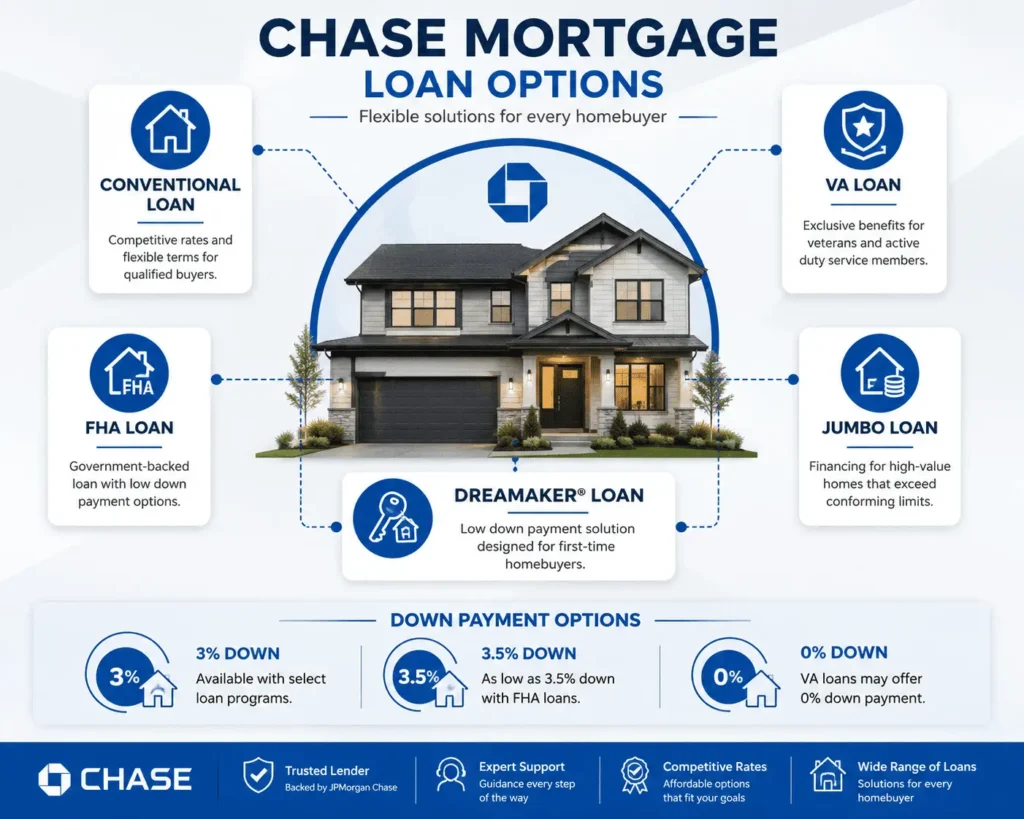
Chase built its lineup to cover almost every kind of buyer. Whether you are purchasing your first starter home or refinancing a jumbo property, there is likely a product built for your situation. Below is a closer look at each option so you can match it to your own plans.
Fixed-Rate and Adjustable-Rate Conventional Loans
Conventional loans make up the bulk of what Chase originates each year. You can choose a fixed rate that stays the same for the life of the loan, or an adjustable rate that starts lower and shifts later. Terms typically run between 15 and 30 years. Most borrowers pick the 30-year fixed option for lower monthly payments.
FHA-Backed Financing
FHA loans through Chase are backed by the federal government, which lowers the risk for the lender. This usually means an easier path for buyers with lower credit scores or smaller savings. Down payments can start as low as 3.5 percent. Some FHA borrowers may also qualify for the Chase homebuyer grant to cover part of their upfront costs.
VA Loans for Military Borrowers
Veterans, active service members, and some surviving spouses can apply for a VA loan through Chase. These loans often require no down payment at all. Chase does not disclose exact credit thresholds for VA loans publicly, but approval tends to be more flexible than conventional financing. This program remains one of the strongest benefits available to military families.
Jumbo Financing for High-Value Homes
If your home price exceeds the conforming loan limit, you will need jumbo financing. Chase handles a large volume of these loans compared to many competitors. Down payment requirements are higher, often starting near 15 percent for second homes and 20 percent for investment properties. Chase can finance amounts up to $9.5 million depending on the property and your qualifications.
Low-Down-Payment Options: DreaMaker and Standard Agency
The Chase DreaMaker loan lets qualified buyers put down as little as 3 percent. It comes with flexible credit guidelines but does require you to meet certain income limits based on where you live. The Standard Agency loan works similarly but skips the income restriction entirely. Both programs were built with first-time buyers in mind.
Refinancing With Chase
Chase offers rate-and-term refinancing as well as cash-out refinancing for homeowners who want to tap their equity. You can also refinance into an energy-efficient mortgage if you plan home upgrades. If your current loan sits with a different servicer, checking your exact payoff amount before you refinance keeps the process moving without surprise delays.
Home Equity Line of Credit (HELOC)
Chase brought back its HELOC product after a break, and it works on a rotating credit line instead of a lump sum. The draw period runs three years, followed by an interest-only stretch, then a longer repayment window. It is worth noting that Chase does not offer a traditional home equity loan, only this line-of-credit format. Borrowers who want a fixed lump sum will need to look elsewhere for that specific product.
Current Interest Rates and How Chase Prices Its Loans
Chase updates its published rates daily, Monday through Friday, based on your ZIP code. Recent data shows Chase mortgage rates sitting close to the national average, sometimes even slightly below it depending on loan type and credit profile. The bank does not require a hard credit pull just to view a sample rate online. If you already have a loan with another servicer, it can help to compare current rate trends before deciding whether refinancing makes financial sense.
Your final rate depends on several factors working together. Credit score, loan type, down payment size, and property location all shift the number up or down. Existing Chase banking customers may also unlock a small discount on top of the standard rate. It pays to get a personalized quote rather than relying on advertised averages alone.
Qualifying for a Chase Mortgage
Every lender sets its own bar for approval, and Chase mortgage requirements shift slightly by loan type. Knowing these numbers ahead of time saves you from wasted applications. The table below breaks down the basics for quick reference.
| Loan Type | Minimum Credit Score | Minimum Down Payment |
|---|---|---|
| Conventional | 620 | 3% |
| FHA | 620 | 3.5% |
| VA | 620 | 0% |
| Jumbo | 680 | 15–20% |
Minimum Credit Score Thresholds
Chase generally asks for a 620 credit score on conventional, FHA, and VA loans. Jumbo loans carry a stricter requirement, usually starting around 680. Chase does not publish exact income requirements, so your approval odds depend on your full financial picture. A higher score almost always leads to a better rate offer.
Down Payment Expectations
Down payments vary widely depending on which program you pick. Conventional and DreaMaker loans can start as low as 3 percent. FHA sits slightly higher at 3.5 percent, while VA loans can require nothing down at all. Jumbo loans demand the most upfront cash, especially for second homes or investment properties.
Guidance for Self-Employed Applicants
Self-employed borrowers face extra paperwork with almost any lender, and Chase is no different. You should expect to provide two years of tax returns along with profit and loss statements. Underwriters look for consistent income rather than one strong year followed by a weak one. Working through a few free mortgage calculators beforehand can help you estimate what payment your income can realistically support.
Grants, Discounts and Incentives Chase Offers Buyers
The Chase homebuyer grant is one of the more generous perks in the industry, offering $2,500 to $7,500 depending on your location and loan program. This money must first go toward lowering your interest rate, then any leftover amount can apply to closing costs or your down payment. Chase also backs a $5,000 closing guarantee, promising a payout if the loan does not close on time due to lender delays. On top of that, existing customers can receive a rate discount ranging from a quarter point up to a full percentage point.
Friends and family members of Chase employees receive a smaller additional discount as well. None of these incentives are guaranteed for every borrower, since eligibility depends on income, property location, and loan type. Still, stacking even one or two of these programs can meaningfully lower your total borrowing cost.
What You’ll Pay in Closing Costs and Lender Fees
Chase does not post a fixed fee schedule on its website, since costs shift based on loan amount, property type, and state rules. Based on recent federal data, the average total cost of a Chase mortgage landed near $5,000, which sits below the industry average. This figure includes both lender charges and third-party costs like appraisal and title fees. Homeowners insurance is another piece of the puzzle, and understanding how escrow and insurance payments get handled after closing helps you budget more accurately for the months ahead.
If you want a personalized breakdown of expected closing costs before you commit to a lender, reaching out to a licensed advisor at james@allthings-mortgage.com can help you compare numbers side by side. A second opinion rarely hurts when real money is on the line.
Step-by-Step: Applying for a Mortgage With Chase
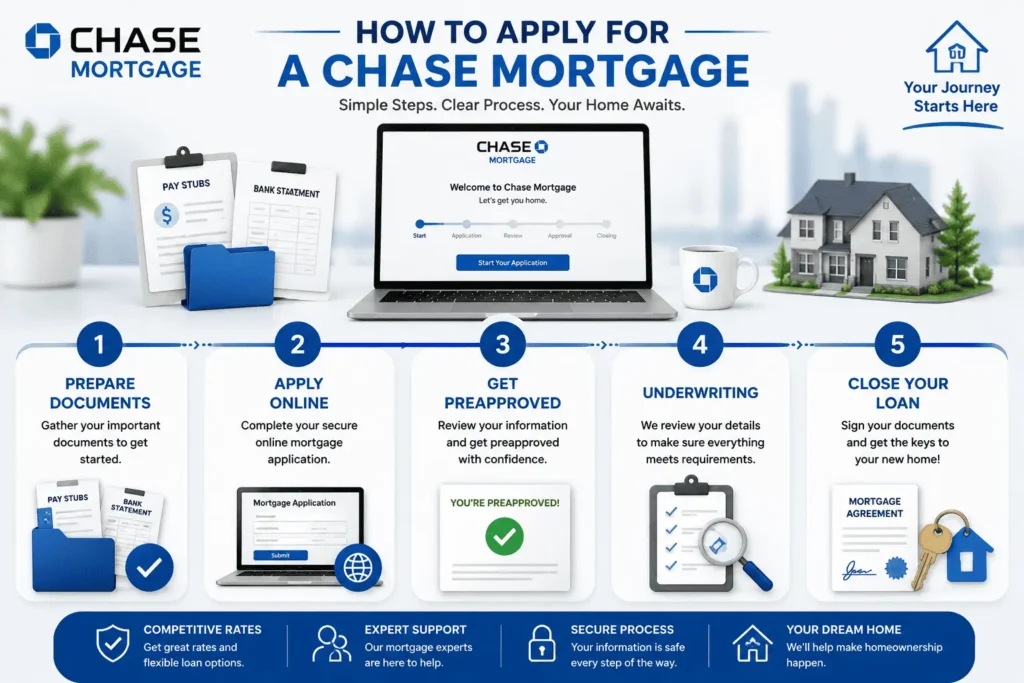
Getting from initial interest to a closed loan follows a fairly predictable path. Knowing the steps ahead of time keeps stress levels lower. Below is what most borrowers can expect.
Paperwork to Prepare in Advance
- Recent pay stubs covering the last 30 days
- W-2 forms showing two years of employment history
- Bank and investment account statements from the past three months
- A signed purchase contract once you have an accepted offer
- Tax returns if you are self-employed or have variable income
Applying Online Versus Visiting a Branch
Chase gives you the choice between a fully online application and an in-person visit. The online path requires creating a profile before you can submit documents digitally. Branch visits work well if you prefer talking through options face to face with a home lending advisor. Both paths lead to the same underwriting process behind the scenes.
How Long Preapproval Takes
Preapproval can often be completed within a few business days once your documents are uploaded. Full underwriting and closing typically take longer, often three to five weeks depending on the loan type. Chase advertises a three-week closing guarantee for eligible conventional loans. Delays usually come from missing paperwork rather than the bank itself.
Managing Your Loan Through the Chase MyHome Portal
Once your Chase mortgage closes, the MyHome dashboard becomes your main hub for everything loan related. You can view your balance, track home value estimates, and manage escrow details from one screen. The portal also lets you schedule payments on a monthly, biweekly, or twice-monthly basis, whichever fits your budget best. If your loan ever transfers to a different servicer down the road, learning how a new online login system works ahead of time prevents any missed payment confusion.
Automatic payments remain one of the simplest ways to avoid late fees. Setting up autopay through your servicer’s portal takes only a few minutes and removes the guesswork from due dates. Chase also sends alerts for account activity if you choose to enable them.
Getting Support From Chase’s Mortgage Team
Chase offers several ways to reach a real person about your loan. Phone support, branch visits, and a mobile app chatbot are all available, though live online chat with a human is not currently offered. Borrowers who call in are usually asked to enter their loan number through an automated system first. Keeping that number handy speeds up every future call.
If you ever compare Chase’s support against a smaller loan servicer, checking how phone support and hold times work elsewhere gives you a useful benchmark. For buyers who want independent guidance before choosing a lender at all, emailing james@allthings-mortgage.com connects you with someone outside the bank who can walk through your options honestly.
Is Chase Reliable? Ratings, Reviews and Complaint Trends
Numbers only tell part of the story, so it helps to look at how real borrowers rate their experience too. Independent research groups track satisfaction separately from the bank’s own marketing claims. Here is what the data shows.
Origination and Servicing Satisfaction Scores
Chase scored 771 out of 1,000 in a recent origination satisfaction study, beating the industry average of 760. Its servicing score came in at 650 against an average of 596, also landing above the norm. Zillow reviewers rated the lender close to 4.95 out of 5 stars across thousands of submissions. These numbers suggest most borrowers walk away satisfied with the process.
BBB Standing and Recurring Borrower Complaints
Chase holds an A+ rating with the Better Business Bureau, which reflects how it handles formal disputes. Federal complaint data shows several hundred mortgage-related complaints filed in a recent year, with payment processing issues appearing most often. Chase closed the large majority of these complaints with an explanation rather than financial relief. This pattern is common among large national banks handling high loan volumes.
Chase Versus Other Major Lenders
Comparing Chase mortgage options against competitors helps put its strengths into perspective. Rocket Mortgage often matches Chase on customer service scores but leans more heavily into a fully digital process. Bank of America offers larger homebuyer grants in some markets, reaching up to $10,000 for qualified buyers. Smaller regional lenders sometimes beat Chase on rate flexibility but cannot match its branch footprint or brand recognition.
The right choice depends on what you value most. Borrowers who want in-person guidance often lean toward Chase or another large bank. Buyers focused purely on the lowest rate might shop three or more lenders before committing to any single one.
Who Chase Is the Right Fit For
A Chase mortgage tends to work best for borrowers who already have a banking relationship with the company or want access to physical branches. First-time buyers chasing a low down payment through DreaMaker also find real value here. Jumbo loan shoppers benefit from Chase’s deep experience funding larger loan amounts. On the other hand, buyers who want the absolute lowest fees with zero branch visits might find a smaller online-only lender better suited to their style.
Common Questions About Chase Mortgages
Most borrowers land on a few of the same sticking points before applying. Rate discounts, HELOC availability, and closing timelines come up again and again in reviews and forums. Tax season also brings its own wave of questions once your loan is active, and pulling your year-end mortgage tax forms correctly matters no matter which servicer eventually handles your account. Addressing these points early prevents confusion later in the process.
Conclusion
Choosing between lenders always comes down to matching your situation with the right program. A Chase mortgage offers wide loan variety, solid customer satisfaction scores, and generous grants for qualified buyers, though it does ask for a bit more paperwork upfront than some smaller lenders. As promised at the start, you now have the full picture of rates, requirements, fees, and support options laid out clearly. Use this guide as your checklist before you pick up the phone or start an application. The right lender is the one that matches your numbers, not just the biggest name on the building.
Frequently Asked Questions
What credit score do I need for a Chase mortgage?
Chase typically requires a 620 credit score for conventional, FHA, and VA loans. Jumbo loans need a higher score, usually starting around 680. Your exact rate still depends on your full financial profile, not just this one number.
Does Chase offer home equity loans?
No, Chase only offers a home equity line of credit, known as a HELOC. It does not currently offer a traditional lump-sum home equity loan. The HELOC includes a three-year draw period followed by repayment.
How long does Chase take to close a loan?
Chase advertises a three-week closing guarantee on eligible conventional loans. Full underwriting for other loan types can take three to five weeks. Delays usually happen when paperwork is incomplete or missing.
Is Chase good for first-time homebuyers?
Yes, the DreaMaker and Standard Agency programs were designed specifically for first-time buyers. Both allow down payments as low as 3 percent. Homebuyer grants can also reduce upfront costs significantly.
Can I negotiate my Chase mortgage rate?
You cannot negotiate the published rate directly, but you can lower it through discounts. Existing banking customers, grant eligibility, and strong credit scores all help secure a better number.