Table of Contents
You open three browser tabs comparing home loans, and none of them show the same number twice. Maybe you typed the same search late last night, hoping one page would finally give you a straight answer. That mix of confusion and frustration is common among home buyers this year, and it usually means the page you found is outdated or missing key details. A quote that changes every time you refresh the screen does not help anyone plan a real budget.
This guide fixes that problem. It walks you through Chase mortgage rates in plain language, covering what pushes them up or down, how the bank locks in a number, and how to compare offers before you sign anything. By the end, you will know exactly what to check before you call a lender, and you can reach out to james@allthings-mortgage.com anytime you want a second set of eyes on your numbers.
Current Chase Mortgage Rates
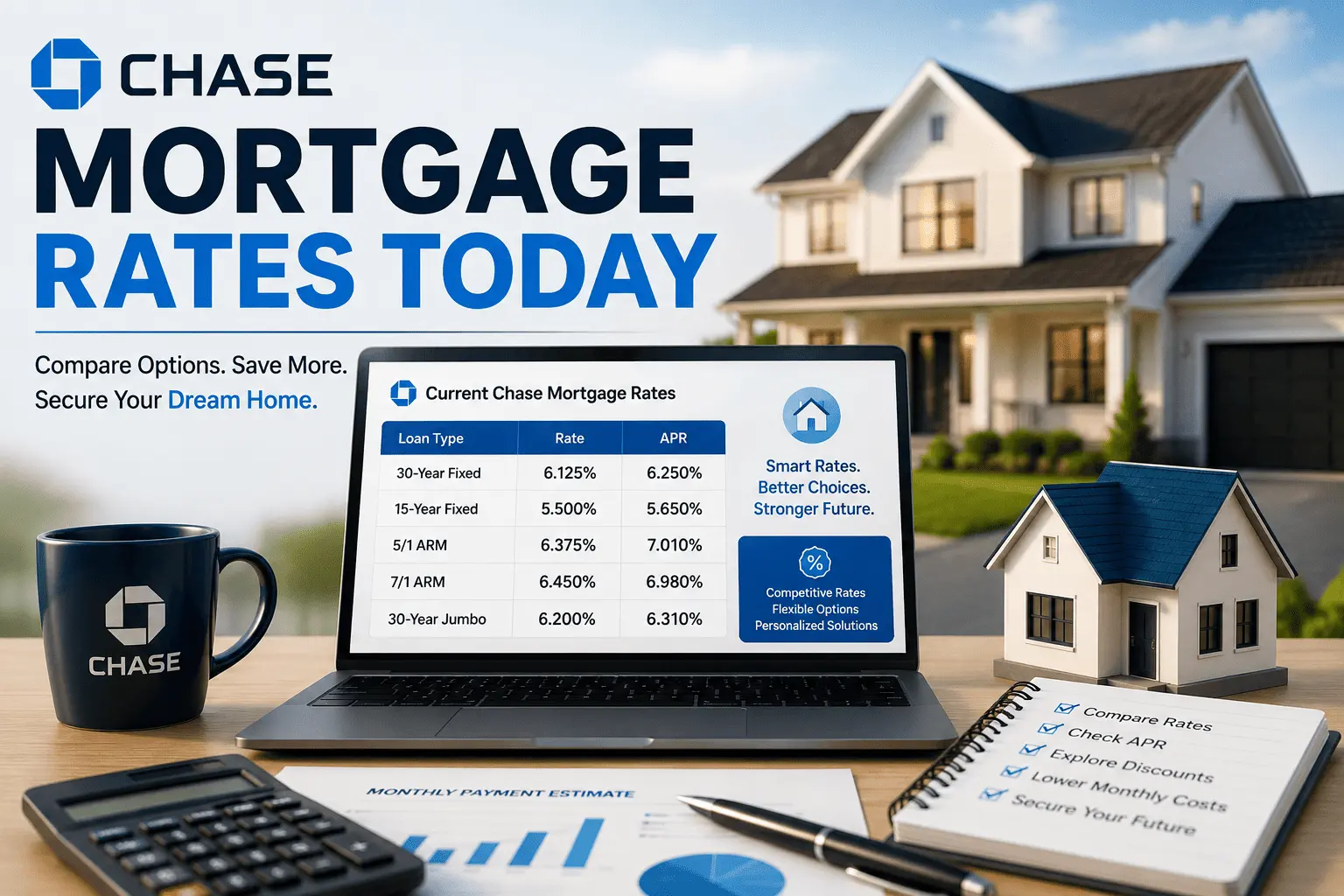
Chase publishes rates for a handful of loan types, and it refreshes them on most business days. The numbers below reflect typical posted rates and assume strong credit, a standard down payment, and about one discount point. Your own rate can land higher or lower once a loan officer reviews your full file. Treat this table as a starting point rather than a final answer for your loan.
| Loan Type | Rate | APR |
| 30-Year Fixed | 6.125% | 6.250% |
| 15-Year Fixed | 5.500% | 5.650% |
| 5/1 ARM | 6.375% | 7.010% |
| 7/1 ARM | 6.450% | 6.980% |
| 30-Year Jumbo | 6.200% | 6.310% |
These figures move with the bond market, so check them the same day you plan to apply. A quarter point swing on a 30-year loan can shift your monthly payment by fifty dollars or more.
How Often Chase Updates Its Mortgage Rates
Chase adjusts its posted numbers on business days, Monday through Friday. There is no fixed clock for these changes, so a rate can move once or several times before markets close. Weekends and holidays usually leave the posted rate untouched since bond markets are shut. Checking the page in the morning gives you the freshest figure before you start comparing lenders side by side. Big economic reports, such as jobs data or inflation numbers, often trigger a same-day rate change once they are released.
Interest Rate vs. APR — What Chase Shows You
Your interest rate is the yearly cost charged on the loan amount you borrow. The APR, or annual percentage rate, adds lender fees and discount points on top of that base rate. Chase lists both numbers together so you can judge the full cost of the loan, not just the sticker price. A low interest rate paired with a high APR usually means heavy upfront fees, so always compare both columns before deciding. If you plan to sell or refinance within a few years, focus more on the interest rate since you may never recover those upfront costs.
Why Your Chase Rate Quote May Differ From the Advertised Rate
The rate on the Chase website is a sample, built around one specific borrower profile. That profile usually assumes a high credit score, a set down payment, and one point paid at closing. Change any of those inputs and your real chase mortgage rates quote can move up or down right away. Your ZIP code also plays a part, since Chase adjusts pricing slightly by state and local market conditions.
This is why two neighbors can apply on the same day and walk away with different numbers. Loan amount, property type, and occupancy status all factor into the final price. A second home or rental property usually carries a higher rate than a primary residence. The only way to know your real number is to enter your details directly or speak with a Home Lending Advisor.
Gathering your paperwork early also speeds up the whole process. Should your loan ever move to another servicer down the road, our RoundPoint mortgage tax documents guide and our RoundPoint mortgage phone number guide show what forms to expect and how to reach a real person fast.
Curious what it looks like from the other side of that phone call? Our RoundPoint mortgage careers guide breaks down salaries and hiring steps for people who want to become a loan officer themselves.
Mortgage Points and How They Affect Your Chase Rate
A discount point is an upfront fee equal to one percent of your loan amount. Paying points lowers your interest rate for the life of the loan, which can save money if you plan to stay in the home a long time. Chase often builds one point into its advertised rate, so a zero-point loan usually carries a slightly higher number. Ask your loan officer for a rate sheet showing several point options side by side.
If comparing loan officers and rate sheets has you thinking about the mortgage field as a career, our RoundPoint mortgage careers overview covers high-paying roles and how to break into the industry.
Choosing fewer points means less cash due at closing but a higher monthly payment. Choosing more points does the opposite, trading cash today for savings over time. Run the math on your expected time in the home before picking either path. A short stay usually favors fewer points, while a long stay usually favors more.
Sample Monthly Payments at Current Chase Rates
Seeing the raw percentage is one thing, but the monthly bill is what actually hits your budget. The table below shows estimated principal and interest only, based on a two hundred thousand dollar loan.
| Loan Type | Rate | Monthly Payment |
| 30-Year Fixed | 6.125% | $1,215 |
| 15-Year Fixed | 5.500% | $1,634 |
| 5/1 ARM | 6.375% | $1,248 |
Taxes, insurance, and mortgage insurance are not included in these numbers. Your actual monthly bill will run higher once those costs are added through escrow. A loan officer can build a full estimate that folds in your local property tax rate and homeowners insurance quote.
If your loan is ever sold or transferred after closing, your monthly payment process can look different. Our RoundPoint mortgage payment guide shows every way to pay on time after a transfer, and our RoundPoint mortgage insurance department guide explains how escrow and insurance claims are handled once a different company services your loan.
Chase Mortgage Rates: 12-Month Historical Trend
Rates have moved in a fairly narrow band over the past year, drifting between the high five percent range and the low seven percent range for a standard 30-year fixed loan. Early in the year, rates sat closer to the top of that range as inflation data ran hot. They eased through the middle months as the market priced in slower price growth.
By the most recent quarter, thirty-year rates settled closer to the middle of that band. This kind of movement is normal and tracks broader Treasury yield swings rather than anything unique to Chase. Watching this trend helps you judge whether today’s number is a good moment to lock or a reason to wait a little longer. No one can predict the next move with certainty, so lock decisions should weigh your closing timeline more than a guess about future direction.
What Affects Your Personal Chase Mortgage Rate
No two borrowers get the exact same number, even on the same day. Three main factors decide where you land on the pricing chart. Understanding each one puts you in a stronger position before you apply.
Credit Score
Your credit score is one of the biggest levers on your final rate. Borrowers with scores above seven hundred forty generally see the best pricing Chase offers. Scores in the mid-600s still qualify for many loan programs but usually come with a higher rate. Paying down credit card balances a few months before applying can lift your score enough to matter.
Down Payment Amount
A larger down payment lowers the lender’s risk, which often lowers your rate. Putting down twenty percent also removes the need for private mortgage insurance on conventional loans. Smaller down payments are still possible through FHA or low-down-payment conventional programs. Just expect a slightly higher rate or added insurance cost in exchange for the lower upfront cash.
Loan Term Length
Shorter loan terms usually carry lower interest rates than longer ones. A fifteen-year fixed loan almost always prices below a thirty-year fixed loan from the same lender. The tradeoff is a higher monthly payment since you are repaying the balance twice as fast. Pick the term that fits your monthly budget first, then let the rate difference be a bonus.
Chase Rate Discounts and Special Programs
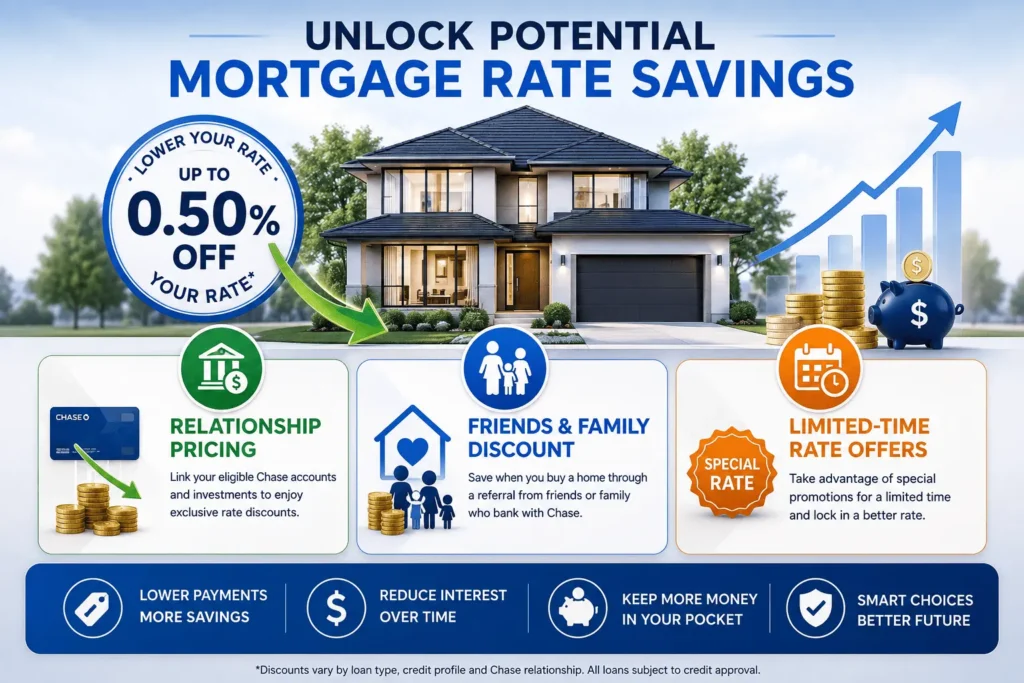
Beyond your credit file, Chase offers a few ways to shave fractions of a percent off your rate. These programs are worth asking about even if you do not think you qualify at first glance. Some stack together for an even bigger discount.
Relationship Pricing Discount
Chase rewards existing customers who keep money parked in eligible accounts. Deposit or investment balances between roughly one hundred eighty-seven thousand and one and a half million dollars can unlock a rate reduction. Balances above that threshold can unlock an even larger discount. This program rewards loyalty, so it pays to ask your banker what tier you qualify for. Moving investment accounts to Chase before you apply can sometimes bump you into a better tier ahead of closing.
Friends and Family Discount
Friends and family members of current Chase employees may qualify for an added rate reduction. This discount is smaller than the relationship pricing tier but can still stack with other offers. Ask directly whether you qualify, since it is not always advertised upfront. Every fraction of a percent matters over a thirty-year term.
Limited-Time Rate Sale Offers
Chase occasionally runs short promotional windows that shave a quarter point off posted rates. These sales usually appear around the busy spring buying season and last only a couple of weeks. Combining a sale with the relationship discount can produce meaningful savings. Watch the bank’s home lending page closely if you are planning to buy during peak season.
The list below sums up the main ways to lower your number:
- Keep a strong credit score before applying
- Maintain qualifying deposit or investment balances
- Ask about limited-time rate sale windows
- Compare point options at the same appointment
How to Lock in Your Chase Mortgage Rate
Once you find a number you like, locking it protects your budget from sudden market swings. Chase offers a few different lock structures depending on where you are in the home search. Picking the right one comes down to timing.
Standard Rate Lock (30–90 Days)
A rate lock freezes your interest rate while your loan moves through underwriting. Chase typically offers lock windows between thirty and ninety days depending on your closing timeline. Locking protects you if rates rise before you close, though it also means you miss out if rates fall. Ask your loan officer to match the lock length to your expected closing date.
Lock and Shop Program
This program lets you lock a rate before you have even found a home. It can hold that protection for up to ninety days while you search. If rates drop significantly during that window, some borrowers may qualify for a one-time adjustment. This tool is useful in a competitive housing market where house hunting can take a while. It removes one layer of stress from the search, since your budget math stays steady while you visit open houses.
One-Time Relock Option
If rates fall after you lock, Chase may allow a single relock to capture the lower number. This option usually comes with conditions tied to timing and market movement. Not every loan file will qualify, so confirm eligibility with your loan officer early. Think of it as a safety net rather than a guaranteed feature.
Once your loan closes, you will manage payments through an online account. If that account ever moves to a new company, our RoundPoint mortgage login guide walks through the first steps after a loan transfer.
Using the Chase Mortgage Calculator to Estimate Your Rate
Chase offers a free online calculator that estimates your monthly payment before you apply. You enter your home price, down payment, and credit score range, and it returns a sample rate and payment. This tool is useful for early budgeting, though it will not replace a formal quote from a loan officer. For a more hands-on way to practice loan math and build comfort with the numbers, our mortgage calculator games guide walks through interactive tools that make the process less intimidating.
Chase Refinance Rates
Refinancing works differently from a first-time purchase loan, even though the rate table looks similar. Chase separates its refinance pricing into two main paths. Picking the right one depends on your goal.
Rate-and-Term Refinance
This option replaces your current loan with a new one at a different rate or term. Homeowners often choose this path to lower a monthly payment or shorten their payoff timeline. Chase evaluates refinance applications using the same credit and equity standards as a purchase loan. Closing costs still apply, so run the breakeven math before committing.
Most homeowners break even within two to four years, depending on how much the new rate drops. A refinance effectively pays off your old loan in full, so the exact figure matters. If your current loan sits with RoundPoint, our RoundPoint mortgage payoff request guide explains how to request that number without delays.
Cash-Out Refinance
A cash-out refinance lets you borrow against your home’s equity and pocket the difference in cash. This route is common for debt consolidation, renovations, or major expenses. Chase requires you to keep a minimum slice of equity in the home after the payout. Rates on cash-out loans usually sit a bit higher than a standard rate-and-term refinance. Lenders view this loan type as slightly riskier, since you are pulling equity out rather than just adjusting terms.
Chase Mortgage Rates vs. Other Lenders
Shopping around is one of the simplest ways to save money on a home loan. Big banks tend to price within a narrow range of each other, but small gaps still add up over thirty years. Here is how Chase stacks up against three other major lenders.
Chase vs. Wells Fargo
Both banks post competitive thirty-year fixed pricing, though the winner shifts week to week with the broader market. Chase tends to edge ahead on relationship pricing for customers with large deposit balances. Wells Fargo offers its own loyalty perks, so the better deal often comes down to where you already bank. Get quotes from both before assuming either one automatically wins.
Chase vs. Bank of America
Bank of America runs a similar relationship discount model tied to deposit and investment balances. Chase and Bank of America frequently land within a few basis points of each other on standard fixed loans. The real difference usually shows up in service speed and the size of the discount tiers offered. Comparing chase mortgage rates directly against Bank of America’s published numbers is the fastest way to spot a gap.
Chase vs. U.S. Bank
U.S. Bank is smaller than Chase but still competes closely on fixed-rate pricing. Some borrowers find U.S. Bank easier to reach for questions due to a smaller customer base. Rate differences between the two are usually minor on a like-for-like loan profile. If your current loan sits with a different servicer, our RoundPoint mortgage rates explained guide breaks down how another major servicer prices its loans for comparison.
Conclusion
For related reading on other loan servicers, see our RoundPoint mortgage address guide if a loan transfer ever changes where your statements come from.
This guide covered how Chase mortgage rates move, what changes your personal number, and how to lock in a rate with confidence. You now know the difference between the advertised rate and your real quote, plus the discounts worth asking about. Use the tables and steps above before you sit down with a loan officer. If you still have questions, james@allthings-mortgage.com is a good place to send them.
Frequently Asked Questions
Are Chase mortgage rates negotiable?
Yes, to a degree. Chase can adjust pricing based on your credit profile, deposit relationship, and loan points chosen. Rates are not fully open to bargaining like a car price, but asking about discounts often lowers your final number.
Does Chase charge discount points by default on advertised rates?
Chase’s published rates usually assume about one discount point is paid at closing. A true zero-point quote will show a slightly higher rate than the number listed on the homepage. Always ask for a side-by-side sheet.
How do Chase’s rates compare to the national average?
Chase typically prices close to the national average for large banks, sometimes just a fraction of a point above it. The exact gap shifts weekly with bond market movement, so check a live rate index alongside Chase’s page.
What credit score do I need for the best Chase mortgage rate?
Scores above seven hundred forty usually unlock Chase’s top pricing tiers. Borrowers in the high 600s can still qualify but should expect a modestly higher rate until their score climbs closer to that threshold.
Can I get a Chase mortgage rate quote without a hard credit check?
Yes. Chase allows a soft credit pull for early rate estimates, which does not affect your credit score. A hard inquiry only happens once you move forward with a full application.